5. RESULTS
5.1. SELECTION OF CONCEPTS REQUIRING A FLEXIBLE DEFINITION
5.1.1. Extraction of terms used in several domains
Each of the 14 domain subcorpora was loaded to TermoStat Web 3.0 in order to obtain a list candidate terms. Only monolexical nouns were extracted. The result was the following:
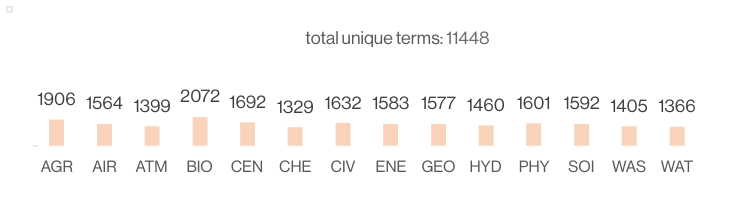
All the candidate terms extracted by TermoStat had a minimum frequency of two occurrences. To ensure representativeness, a term was only considered to be associated with a domain if it had at least 64 occurrences in the corresponding subcorpus (one occurrence per 5,000 words). The 64-occurrence threshold was selected after analyzing the resulting lists with different thresholds. In most cases, a term with fewer than 64 occurrences in a subcorpus was not sufficiently representative. However, we are aware that this threshold eliminated from our working list some relevant associations between terms and domains. Therefore, in a real application of this procedure, the terminologist will likely need to vary the threshold to tailor it to the needs of his/her project. Figure 27 shows the number of remaining terms in each domain and the total number of unique terms after applying the 64-occurrence threshold. Figure 28 shows in how many domains terms appear.
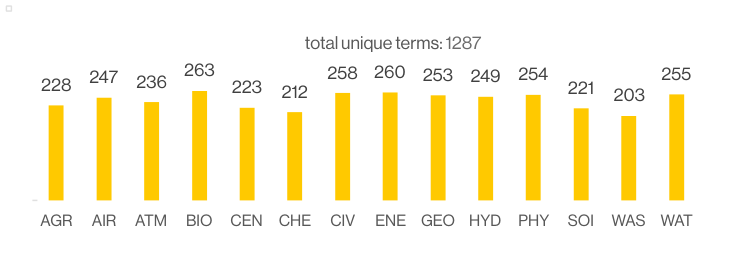
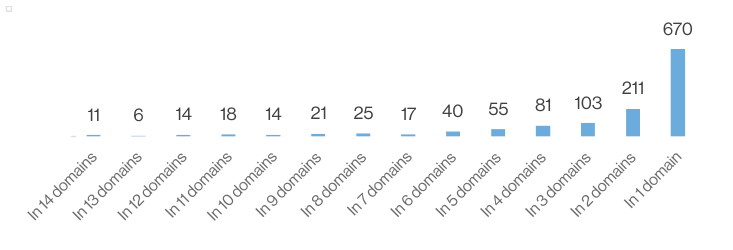
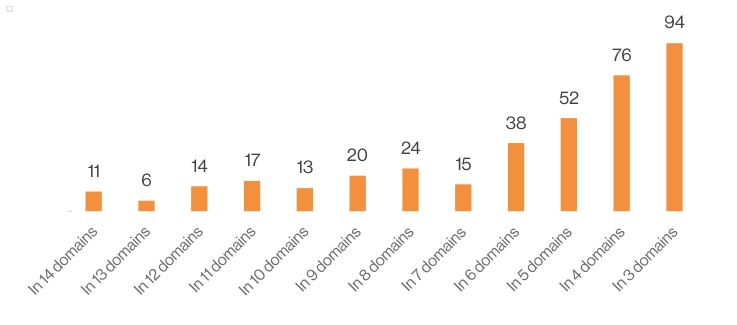
The associated domains and frequency numbers of several terms (such as groundwater/ground-water, vapor/vapour, and sulfur/sulphur) were recalculated to account for spelling variations. From the 64-occurrence- threshold list of terms, only those present in at least three domains were retained, i.e., 405 terms. Then, all abbreviations and acronyms terms were eliminated after manual verification in the corpus. As a result, there were 380 terms distributed as follows:
5.1.2. Filtering out scientific transdisciplinary lexicon units
The 380 terms were compared to the scientific transdisciplinary lexicon (STL) list in order to retain only those not present in the list STL. The STL list used was an expansion of the English list available on the website of the STL projectAvailable at: <http://olst.ling.umontreal.ca/lexitrans/>.. We expanded it following the same guidelines as its developerIn personal communication, Patrick Drouin, main developer of the STL, informed me that the English STL was currently being enriched with morphological derivates and translations from the French STL list.. Consequently, after automatic filtering, we classified as an STL unit each term that was not originally detected as such whether it was a morphological derivative of an STL unit already in the English list or whether it had an equivalent in the French list. The final result is shown in Table 30.
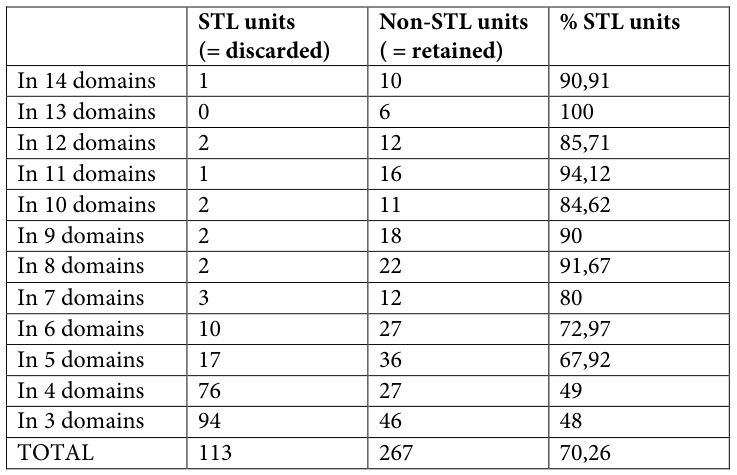
Table 30. Number of STL units, non-STL units, and percentage
Not surprisingly, since our method of finding contextually variable terms in different domains is similar to the one used by Drouin (2007; 2010b) to draw up the STL list, more than 70% of the terms coincide. However, since Drouin’s extraction included many other domains in addition to the environment, the elimination of STL units ensured that the terms were specific to the environmental domain.
5.1.3. The final working list
In order to obtain the final list, only the terms whose referent is an entity (abstract or concrete) were retained. In other words, we excluded concepts referring to attributes, states, and processes. The following table shows the final working list of terms with their frequency in each domain (when the frequency is lower than 64, a hyphen is inserted):
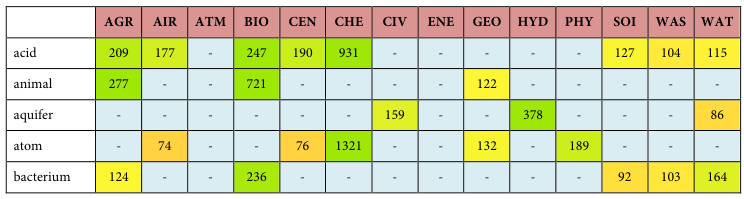
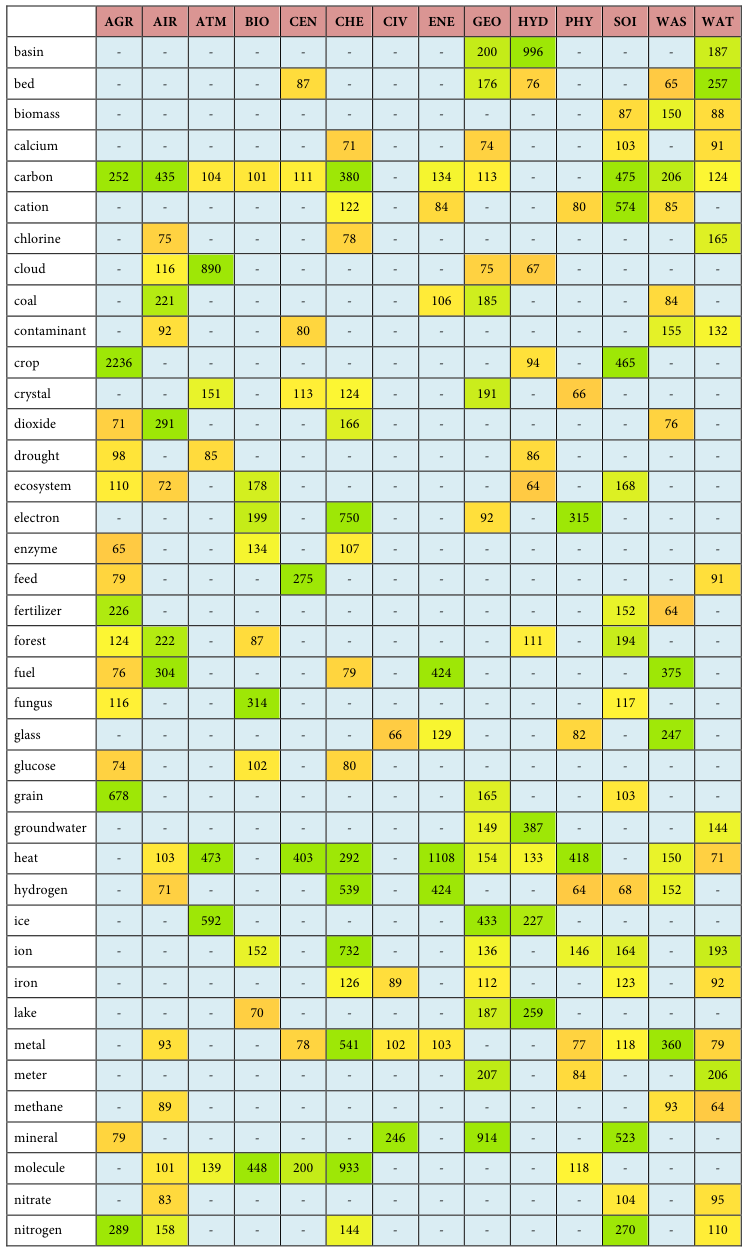
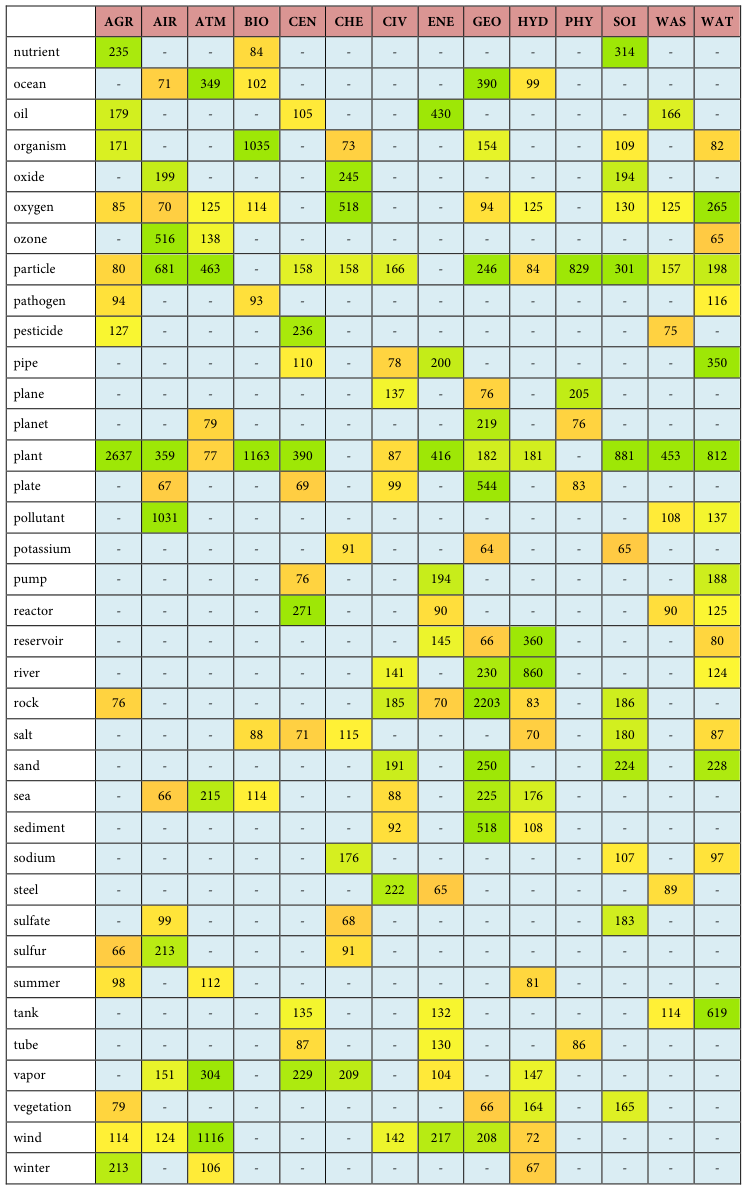
Table 31. Final working list of terms
5.1.4. Polysemous terms
As indicated in §3.5.3.5.1, the distinction between polysemy and contextual variation is fuzzy. However, within the framework of a resource that uses flexible definitions, as defended in this thesis, the impact of sense splitting or lumping is reduced, because not only is polysemy represented but also contextual variation.
It is important to note that the concepts associated with a polysemous term experience contextual variation as well. Nevertheless, since our focus is on contextual variation, with the intention of avoiding interference, polysemous terms were discardedSince our corpus was POS-tagged, terms belonging to more than one part of speech were not considered polysemous for our purposes..
In order to classify a term as polysemous, we used our corpus as a point of reference. In other words, only those terms that appeared as polysemous in our corpus were treated as such, even if their polysemous status was well identified in dictionaries or other terminographical sources. For instance, the term atom was included in the analysis because, in spite of being polysemous (ATOM_1: a unit of matter consisting of a single nucleus surrounded by a number of electrons equal to the number of protons in the nucleus / ATOM_2: a number or symbol of a measure algebra other than zeroThe source of both definitions is TERMIUM Plus (Translation Bureau / Bureau de la traduction [Canada] 2015).), only occurrences of ATOM_1 were found in our corpus.
The instances of non-linear polysemyNon-linear polysemy is the type of polysemy that occurs when there is no relation of inclusion between polysemous words (Cruse 2011: 115). were identified by means of the tests in §3.5.3.5.1. In those cases in which the tests were not conclusive, they were considered polysemous.
What Cruse called facets, i.e., terms with two related senses that belong to different ontological categories (but that can be reunited in certain contexts) were considered polysemous. The reason is that it is a phenomenon not related to domain-specific contextual variation, and, therefore, it is beyond the scope of this work. Furthermore, EcoLexicon treats them as polysemous terms. For example, pollution was considered polysemous because it has a PROCESS facet (the process of polluting) and an ENTITY facet (substances that pollute). Nonetheless, we believe that further study is needed to decide whether this is the best option for EcoLexicon and how to streamline the representation of regular polysemy.
Autohyperonimic and automeronymic senses were considered polysemous if the different senses were not linked to different domains. For example, the term oil can refer to a kind of unctuous liquid substance or to petroleum, which is a subtype of the first sense. The term oil refers to any of the two senses in any domain.
The list of polysemous terms with a definition for each sense is in Annex 2.
5.2. ADAPTING THE TYPES OF CONTEXTUAL VARIATION
After the analysis of all the terms in our working list, it became evident that the division of contextual variation in microsenses (including local sub-senses) (§3.5.3.5.4), WOS (§3.5.3.5.3), and modulation (§3.5.3.5.2) was not adequate for our purposes.
Our notion of domain-dependent contextual variation includes three phenomena: (i) modulation (similar to Cruse’s modulation); (ii) perspectivization (related to Cruse’s WOS); (iii) subconceptualization (akin to Cruse’s microsenses and local sub-senses). These phenomena are additive in that all concepts experience modulation; some concepts also undergo perspectivization; and finally a small number of concepts additionally are subjected to subconceptualization.
5.2.1. Modulation
Our notion of modulation is similar to Cruse’s. It is the simplest kind of contextual variation. In this work, we regarded contextual modulation as a type of contextual variation that solely alters minor non-necessary and non-prototypical characteristics of a concept. As a consequence, these alterations are not represented in a definition. If a concept only undergoes modulation in a given domain, then no flexible definition is created for it. For instance, BREAKWATER, which is a type of coastal defense structure, is only modulated in AGRONOMY. BREAKWATER is so seldom activated in that domain that no different necessary or prototypical characteristics are conventionally attached to the concept in that context with respect to the general environmental premeaning.
5.2.2. Perspectivization
For a premeaning to be considered a perspective, it needs to change the level of prototypicality of certain traits of a concept in a consistent way in relation to the general environmental premeaning. For example, SULFUR is conceptualized from two distinct perspectives in AGRONOMY and AIR QUALITY MANAGEMENT. In AGRONOMY, SULFUR is an important nutrient that plants need for different functions, such as chlorophyll production. In AIR QUALITY MANAGEMENT, SULFUR (as part of sulfur dioxide) is a major air pollutant that can have severe effects on the environment and human health.
Perspectivization is related to Cruse’s WOS, but differs from it in two ways. The first is that Cruse’s WOS are opposed to microsenses. In other words, if a premeaning is considered to be a microsense, then it is not a WOS and vice versa. However, in our approach, perspectives and subconceptualizations are not in opposition to each other. In fact, all subconceptualizations also include a perspective.
The second way that our notion of perspective differs from Cruse’s WOS is that we use Pustejovsky’s (1995) qualia roles differently. Cruse characterizes the WOS adopted by a domain with qualia roles. Nonetheless, we defend that the prevailing qualia role for a concept should be determined at frame level and not at domain level. The reason for this is that, in a given domain, a concept may participate in several frames at the same time. As a consequence, different qualia roles could be assigned in the same domain depending on the activated frame. For example, the concept FUNGUS in AGRONOMY can be seen from a telic-agentive perspective if FUNGUS is conceptualized in the frame of MUSHROOM CULTURE. FUNGUS can also be construed from a different telic perspective if it is categorized as a PEST.
As explained in §3.6.4, genus choice in flexible definitions is guided by qualia roles. In the case of a concept that activates several frames such as FUNGUS, the most frequent frame according to corpus analysis is used to select the genus. However, if possible, the role of the concept in the other relevant frames is to be represented in the definition for a given domain as well. For instance, FUNGUS in AGRONOMY would take PEST as a genus, but the fact that it can be cultivated should also be featured in the definition.
5.2.3. Subconceptualization
Our third type of contextual variation is subconceptualization. It includes both Cruse’s microsenses and local sub-senses. Nonetheless, it is even more general, since there were cases where a concept manifested contextual variation akin to these two kinds but did not meet all the requirements.
For our purposes, we define a subconceptualization as a premeaning in which the extension of the concept in relation to the reference point (in our case, the general environmental premeaning) is modified. For instance, the concept CRYSTAL gives rise to a subconceptualization in ATMOSPHERIC SCIENCES because the extension of the concept is restricted to CRYSTALS made of ICE in that domain.
Nevertheless, it should be highlighted that subconceptualization is not a clear-cut phenomenon. Since a subconceptualization relies on the notion of conceptual extension, it is inherently fuzzy. As shown in §2.1.3.2, conceptual limits are fuzzy and show prototypical effects.
The upper limit of a subconceptualization is polysemy: when the subconceptualization shows too much autonomy. The lower limit is perspectivization, which is when a context-variable trait is not strong enough to be considered extension-changing.
In both cases, we believe that the decision whether to regard a premeaning as a separate concept, a subconceptualization or a perspective must be made depending on user needs and the characteristics of the resource where the concept or concepts are to be represented.
None of our analyzed concepts met all the requirements to be considered a microsense strictly in the way that Cruse described them. Nevertheless, some concepts did manifest one of its main characteristics, namely, that the relation between the general environmental premeaning and the domain premeaning is hierarchical. This is the reason why we have named this phenomenon subconceptualization.
The main difference between perspectivation and subconceptualization regarding terminological definitions is that a contextualized definition for a subconceptualization represents as necessary a trait that in the general environmental definition does not have necessary status. This is not possible in a contextualized definition that is only a perspective. For instance, for an entity to be considered a CONTAMINANT in WATER TREATMENT AND SUPPLY, it needs to contaminate water, which becomes a necessary characteristic. Therefore, CONTAMINANT is subconceptualized in that domain. However, HYDROGEN in ENERGY ENGINEERING is not a subconceptualization, but simply a perspective. Although it is conceptualized as used for energy storage, this is not a necessary characteristic. In other words, an entity will still be considered HYDROGEN in that domain even if it is not used for that purpose.
The complexity of the phenomenon of subconceptualization and the different degrees in which it manifested itself was evident during our analysis. The following sections comment on certain factors that affected the identification of subconceptualizations and the implications for their practical application to the terminological definition.
5.2.3.1. The entrenchment of the general environmental premeaning
Our point of reference is what we have called the general environmental premeaning. A subdomain premeaning is compared to the general environmental premeaning in order to determine whether there is a subconceptualization. However, the entrenchment of the general environmental premeaning is in many cases doubtful, which, at the same time, is one of the reasons why flexible definitions are necessary.
The general environmental premeaning is a summary of the most relevant characteristics of a given concept across its domain-specific conceptualizations. Most of the time, in the general environmental domain, there is not a clear frame associated with the concept, but rather several of them in different subdomains. Moreover, different premeanings may have different levels of prototypicality when taken into account together in the whole environmental domain. In conclusion, since our point of reference normally lacks entrenchment, this also hinders the clear identification of subconceptualizations.
5.2.3.2. The entrenchment of subconceptualizations
The phenomenon of subconceptualizations occurs when, in a certain domain, a concept is construed in such a way that the resulting premeaning is a subtype of the concept. In other words, the extension of the concept is modified (and, more often than not, restricted). Nonetheless, there are cases where the subconceptualization seems to be weaker than in other cases, and this hinders the identification of subconceptualizations.
For instance, POLLUTANT has its extension limited in the domain of AIR QUALITY MANAGEMENT to those agents that pollute the air. In the general environmental premeaning, POLLUTANT includes any agent that pollutes any kind of environment. However, in the AIR QUALITY MANAGEMENT subcorpus, the complex terms air pollutant and atmospheric pollutant were fairly frequent (164 occurrences out of a total of 1,092 occurrences of pollutant in the AIR QUALITY MANAGEMENT subcorpus). This need for specification is indicative of weaker entrenchment.
In contrast, the subconceptualization of DROUGHT in AGRONOMY shows greater entrenchment than the one of POLLUTANT in AIR QUALITY MANAGEMENT. In our AGRONOMY subcorpus, the term drought was never preceded by a modifier that indicated the subconceptualization, only adjectives that qualified drought mainly in terms of its severity or length:

Table 32. Concordances of the lemma drought (noun) preceded by a modifier in the AGRONOMY subcorpus
5.2.3.3. The problem of the subconceptualization’s extension
POLLUTANT is prototypically preconceptualized as an AIR POLLUTANT in the domain of AIR QUALITY MANAGEMENT. It is not a case of polysemy; it is simply that context narrows the extension of the concept by default (a subconceptualization). The problem is that in EcoLexicon, AIR POLLUTANT is an independent concept in itself. In other words, the subconceptualization’s extension (POLLUTANT in AIR QUALITY MANAGEMENT) corresponds to another concept’s extension (AIR POLLUTANT).
In this case, AIR POLLUTANT is a relevant concept in the domain of AIR QUALITY MANAGEMENT. The definition of POLLUTANT for the domain of AIR QUALITY MANAGEMENT will consist of a hyperlink to the definition of AIR POLLUTANT in that same domain:

Table 33. Definition of POLLUTANT in AIR QUALITY MANAGEMENT
The case of FUEL is different. The extension of the subconceptualization of FUEL in AGRONOMY corresponds to the extension of CHEMICAL FUEL (in contrast to NUCLEAR FUEL). However, CHEMICAL FUEL is not a relevant concept in the domain, since the term chemical fuel does not appear in the AGRONOMY subcorpus. In this case, the definition for FUEL describes the subconceptualization and the perspective, but no explicit reference is made to the concept CHEMICAL FUELAn extract of the contextualized definition of FUEL in AGRONOMY is shown in Table 50..
5.2.3.4. The problem of the hierarchical organization
The representation of the subconceptualization structure formed by the general environmental premeaning and its subconceptualizations in flexible definitions are highly dependent on the domain hierarchy being used and its depth. For instance, taking Cruse’s example of ball, the resulting subconceptualization (TENNIS BALL, GOLF BALL, etc.) could not be accounted for in a flexible definition if the domain Sports was not subdivided.
The mismatch between the subconceptualization structure and our domain hierarchy occurred frequently. For example, the concept SUMMER has two subconceptualizations: one in ASTRONOMY, and one in ATMOSPHERIC SCIENCES, particularly in METEOROLOGY. On the one hand, the astronomical subconceptualization limits the extension of SUMMER from the summer solstice to the autumnal equinox, thus covering the months of June (partially), July, August, and September (partially) in the Northern Hemisphere, and December (partially), January, February, and March (partially) in the Southern Hemisphere. On the other hand, in ATMOSPHERIC SCIENCES, SUMMER covers June, July, and August in the Northern Hemisphere, and December, January, February in the Southern Hemisphere.
The problem arose when that subconceptualization structure was mapped onto those domains in which the term summer had more than 64 occurrences: AGRONOMY, ATMOSPHERIC SCIENCES, and HYDROLOGY. Firstly, ASTRONOMY is not part of our domain hierarchy. Secondly, while ATMOSPHERIC SCIENCES has its own subconceptualization, AGRONOMY and HYDROLOGY’s premeanings include both the astronomical and meteorological subconceptualizations along with a geographical factor (the perceived start and end of the summer depends on the meteorological conditions of a given place), similarly to the general environmental premeaning. Nevertheless, having a similar extension does not mean that the definitions will be the same, since, as previously mentioned, concepts also undergo perspectivization in each domain.
Cruse presented microsenses as being hierarchical and incompatible between domains. However, our notion of subconceptualization is more flexible because it permits several domains to share the same subconceptualization (though with different perspectives). Furthermore, subconceptualizations do not need to be incompatible. For instance, in the case of POLLUTANT, a HEAVY METAL is at the same time a kind of POLLUTANT in AIR QUALITY MANAGEMENT and WATER TREATMENT AND SUPPLY, even if they have different subconceptualizations.
5.3. CONCEPT ANALYSIS
5.3.1. Chemical elements
Our first set of analyzed concepts corresponds to those that are categorized as CHEMICAL ELEMENTS in the domain of CHEMISTRY. The terms corresponding to these concepts and their occurrence in each subdomain corpus are shown on Table 34.

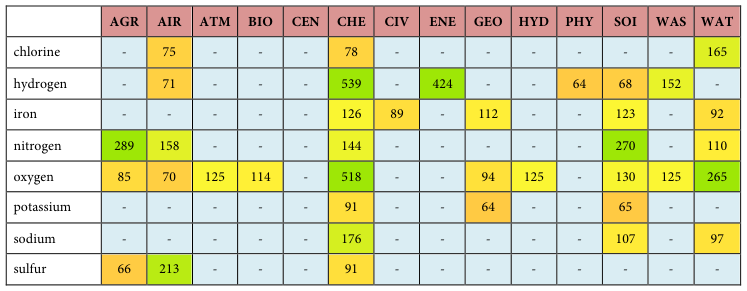
Table 34.Terms whose corresponding concepts can be categorized as CHEMICAL ELEMENTS
Most of the known chemical elements occur naturally in the environment, as is the case of the ten elements analyzed in this work. CHEMICAL ELEMENTS are substances that cannot be decomposed into simpler substances. The elements can appear in different forms. More specifically, the bonding between the atoms of an element may vary resulting in allotropes (e.g., ozone is an allotrope of oxygen); the number of neutrons of an atom may change originating isotopes or the same element (e.g., chlorine-35 is the most common stable isotope of chlorine); or an atom or molecule of an element may gain or lose electrons becoming an ion (e.g., if a calcium atom loses electrons, it becomes a calcium ion). Furthermore, elements may either be pure or appear with other elements in compounds or mixtures, or in different states (mainly, solid, liquid, or gas).
However, whatever the form of an element, the number of protons in its atoms remains unaltered. If an element undergoes a change in the number of protons, it becomes another element and thus loses its identity. Moreover, no other characteristic is added by default to the premeanings of CHEMICAL CONCEPTS in the contextual domains analyzed. For instance, for something to be categorized as OXYGEN in BIOLOGY, GEOLOGY, or HYDROLOGY, it needs to have 8-proton atoms. This condition applies in all domains. Since the alteration of necessary characteristics is compulsory for a conceptualization to be a kind of subconceptualization, CHEMICAL ELEMENTS do not give rise to that phenomenon.
In order to verify if a premeaning is a subconceptualization in a given domain, one must ascertain whether the additional characteristics activated are necessary, given the set of contextual constraints. For example, ATMOSPHERIC OXYGEN is the most prototypical type of OXYGEN in ATMOSPHERIC SCIENCES. Nonetheless, when OXYGEN is activated in this domain, “OXYGEN located-in ATMOSPHERE” is not a necessary characteristic. In other words, for an entity to be considered OXYGEN in ATMOSPHERIC SCIENCES, it does not need to be located in the atmosphere, despite the fact that, in this domain, OXYGEN is conceptualized as located in the atmosphere more frequently than in other environmental subdomains. Therefore, the characteristic “OXYGEN located-in ATMOSPHERE” only has prototypical status in ATMOSPHERIC SCIENCES, and the concept OXYGEN only gives rise to a perspective in this domain, not a subconceptualization.
It should also be underlined that, since CHEMICAL ELEMENTS do not give rise to subconceptualizations, when a CHEMICAL ELEMENT is preconceptualized in an environmental subdomain, it does not stand for the most prototypical compound or substance in which it appears. For instance, when the concept CALCIUM is activated in GEOLOGY, it does not stand for CALCIUM CARBONATE (its most usual form in that contextual domain). Instead, the information that CALCIUM prototypically appears as a part of CALCIUM CARBONATE becomes active and should be represented in the corresponding definition.
Nevertheless, in the same way as the other CHEMICAL ELEMENTS, CARBON does not undergo subconceptualization. During the analysis of the term carbon in the contextual domain of AIR QUALITY MANAGEMENT, it was found that sometimes it does stand for the whole compound in which it prototypically appears (CARBON DIOXIDE) or even for all sorts of greenhouse gasses. However, this cannot be considered a subconceptualization, because when the concept CARBON is activated in AIR QUALITY MANAGEMENT, it does not stand for CARBON DIOXIDE by default. It could not be considered a case of automeronymic polysemy either because this usage is limited in our corpus to complex terms such as carbon emission or carbon footprint. Thus, it appears that it is simply a shortened form of carbon dioxide emission or carbon dioxide footprint. In our AIR QUALITY MANAGEMENT subcorpus, when carbon appeared without being part of a noun phrase, it always referred to CARBON and not CARBON DIOXIDE:

Table 35. Concordances of the lemma carbon (noun) in the AIR QUALITY MANAGEMENT subcorpus
As shown, for CHEMICAL ELEMENTS, the forms in which the element prototypically appears in a given domain is a relevant characteristic. To determine them, in addition to reference material, the modifier, modifies, and contextonym word-sketches are very useful. The modifier and modifies word-sketches show the noun phrases in which the lemma appears. For instance, the modified word-sketch for potassium in the GEOLOGY subcorpus (Table 36) shows that potassium feldspar, a type of mineral, is one of the main forms in which potassium is studied in that domain. As can be observed in Table 37, CAST IRON, WROUGHT IRON, and PIG IRON are the most frequent forms of IRON in CIVIL ENGINEERINGIn the case of IRON in CIVIL ENGINEERING, its most prototypical form is CAST IRON (along with PIG IRON, WROUGHT IRON, and STEEL). Although CAST IRON could be regarded as a kind of IRON, it is a material with a very high proportion of iron in its composition, but, strictly speaking, not a type of IRON.. Finally, Table 38 shows how the contextonym word-sketch indicates that in AGRONOMY, SULFUR is prototypically conceptualized as part of SULFATES and SULFIDES.
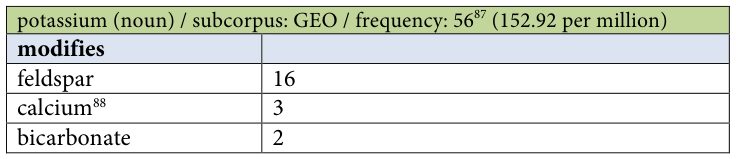
Table 36. Modifies word-sketch of potassium (noun) in the GEOLOGY subcorpus
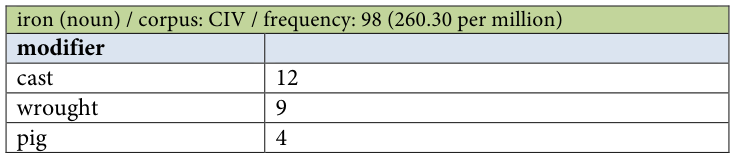
Table 37. Modifier word-sketch of iron (noun) in the CIVIL ENGINEERING subcorpus
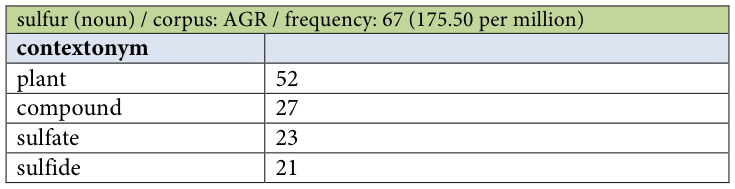
Table 38. Contextonyms of sulfur (noun) in the AGRONOMY subcorpus
It is worth noting that CHEMICAL ELEMENTS show relational and compositional autonomy, as Cruse described for WOS. Relational autonomy in the domain-specific conceptualizations of CHEMICAL ELEMENTS takes the form of multidimensional categorization. In other words, they have different hyperonyms, co-hyponyms, and hyponyms, depending on the subdomain. For instance, in AGRONOMY, NITROGEN has NUTRIENT as one of its hyperonyms, and PHOSPHORUS as a cohyponym. Meanwhile, in AIR QUALITY MANAGEMENT, one of its hyperonyms is ATMOSPHERIC GAS and one of its co-hyponyms is OXYGEN. Concepts tend to have several hyperonyms, and this is one of the difficulties of crafting flexible definitions.
As for compositional autonomy, it is usual for the terms denoting
CHEMICAL ELEMENTS to have different collocations, depending on the domain. In fact, the collocations that a term has in different domains, which can be obtained by means of the various word sketches, are another key to the characterization of the perspective of a concept in a given domain. One example is the adjective usable in conjunction with nitrogen. In our corpus, this adjective is only used with nitrogen in SOIL SCIENCES. It refers to the nitrogen that can be used by plants and thus indicates that nitrogen is an important nutrient for plants.

Table 39. Concordances of the lemmas usable (adjective) and nitrogen (noun) in the SOIL SCIENCES subcorpus
An example of a verb that collocates with a chemical element only in a given domain is liquefy, which takes hydrogen as an object in the ENERGY ENGINEERING domain. This collocation shows that hydrogen needs to be liquefied in order to be used as an energy storage medium in ENERGY ENGINEERING:

Table 40. Concordances of the lemmas liquefy (verb) and hydrogen (noun) in the ENERGY ENGINEERING subcorpus
Finally, some CHEMICAL ELEMENTS in certain contextual domains pose a problem that we have called hyperversality. Hyperversality is a property of certain concepts in relation to a given contextual domain. A concept is considered hyperversatile when it participates in a wide range of frames in a contextual domain. For example, OXYGEN is a hyperversatile concept in most of its contextual domains given that it is the most abundant chemical element on Earth, and since it is highly reactive, it participates in many processes. Therefore, the premeaning of OXYGEN in any of its contextual domains is not linked to only one frame.
Hyperversatility is not absolute; there are degrees, and it is intimately linked to the size of the contextual domains. A concept that is hyperversatile in a given domain tends to be less hyperversatile with respect to its subdomains. For instance, OXYGEN in BIOLOGY is more hyperversatile than in BOTANY.
Hyperversatility is a problem because formulating a flexible definition for a hyperversatile concept entails a longer process of documentation. It is necessary to make sure that the definition summarizes the most important roles of that concept in the contextual domain. In the case of EcoLexicon, hyperlinks in the definitions and the conceptual map ensure that the user can obtain further information if needed.
5.3.2. Chemical compounds and other substances
In this set, we have included concepts that have many conceptual similarities with CHEMICAL ELEMENTS, since, to a varying degree, they have a specific chemical composition that acts as a necessary characteristic. This set of concepts corresponds to those that are categorized as CHEMICAL COMPOUNDS in the domain of CHEMISTRY (in the case of DIOXIDE, GLUCOSE, and METHANE) as well as other concepts that can be categorized as SUBSTANCES but are neither CHEMICAL ELEMENTS nor CHEMICAL COMPOUNDS. This is the case of OZONE (an allotrope of oxygen), ENZYME (a kind of protein), COAL, and STEEL, which can be categorized as SUBSTANCESWe have excluded from this group those concepts that can be categorized as SUBSTANCES, but whose composition is too variable. Such concepts are included in §5.3.5.. The terms corresponding to the concepts in this set and their occurrence in each subdomain corpus are shown in Table 41.
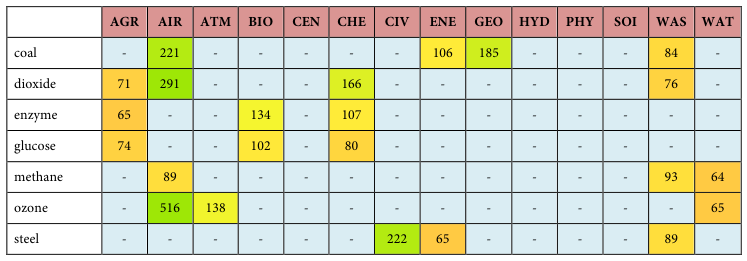
Table 41. Terms whose corresponding concepts can be categorized as CHEMICAL COMPOUNDS or SUBSTANCES
GLUCOSE, METHANE, and OZONE have a chemical formula. The formula, C6H12O6 for GLUCOSE, CH4 for METHANE, and O3 for OZONE, acts as a sufficient and necessary characteristic. Because of their chemical formulas, their contextual behavior resembles that of CHEMICAL ELEMENTS. As a result, they have perspectives but do not give rise to subconceptualizations.
For example, METHANE is conceptualized as a GAS emitted by the decomposition of organic waste in WASTE MANAGEMENT or as a by-product of wastewater treatment in WATER TREATMENT AND SUPPLY. In contrast, in AIR QUALITY MANAGEMENT, it is a GREENHOUSE GAS. In none of the three domains, are the necessary characteristics of METHANE altered. However, the frames in which the concept participates are not the same in every domain, and as a consequence, certain conceptual relations become highlighted and others backgrounded.
In AIR QUALITY MANAGEMENT, the highlighted information for METHANE is that it contributes to the greenhouse effect and that it can be found in the atmosphere due to natural as well as anthropogenic sources. In that domain, its impact on the environment and how it can be managed or reduced are also highlighted. Nonetheless, most of this information is backgrounded in WASTE MANAGEMENT, where the fact that the decomposition of organic waste emits methane is much more relevant.
Although METHANE and OZONE are not hyperversatile in their contextual domains, this is not the case of GLUCOSE in BIOLOGY. GLUCOSE in AGRONOMY activates the frames of PHOTOSYNTHESIS and PLANT RESPIRATION. Therefore, its roles in those frames are explained in the definition. However, in BIOLOGYMost of our concepts are hyperversatile in BIOLOGY because it is a very large domain. In fact, in EcoLexicon, BIOLOGY is subdivided in BIOLOGICAL OCEANOGRAPHY, BOTANY, ZOOLOGY, MICROBIOLOGY, MOLECULAR BIOLOGY, and BIOCHEMISTRY., GLUCOSE participates in many more frames, including PHOTOSYNTHESIS and PLANT RESPIRATION. As a consequence, the definition should be less detailed regarding the roles of GLUCOSE in each frame because, otherwise, the definition would be extremely long.
The composition of COAL and STEEL is variable. Nevertheless, this does not give rise to subconceptualizations. The reason is that, even though varying compositions and properties are possible, in the contextual domains there are no fixed compositions or properties different from the general environmental premeaming of those concepts. For instance, STEEL is an alloy of iron and carbon, and can sometimes contain other elements as well, such as manganese, nickel, chromium, molybdenum, or silicon. There are different types of steel depending on the proportion of its elements or the method of production (among other factors), which make the steel suitable for different uses. However, when STEEL is preconceptualized in one of its contextual domains, there are not any characteristics whose status changes to necessary in these contextual domains (as compared to the general environmental domain). In other words, the extension of the premeanings remains the same as in the general environmental domain. This entails that the conditions required for an entity to be categorized as IRON are the same across environmental domains.
Finally, DIOXIDE and ENZYME are also perspectived, but manifest a kind of hyperversatility that we have called superordinate hyperversatility. This hyperversatility is due to the fact that the concept has many subordinate concepts and each subordinate participates in different frames, which makes the superordinate concept hyperversatile. This causes them to behave as a superordinate-level concept in the domain in question. For instance, ENZYME is a conceptual category that encompasses proteins that act as catalysts in biochemical reactions. Given that each enzyme is specific to a kind of reaction or set of reactions, ENZYME does not participate in any specific frame per se and remains rather generic despite the fact that it is restricted to one contextual domain. This is the case in AGRONOMY, given that plants and the soil contain an enormous variety of enzymes with very different functions.
Superordinate hyperversatility can be generally detected by means of the modifier word-sketch if the term has modifiers that refer to subtypes. However, the terms for subtypes of ENZYME do not contain the term enzyme. In this case, they need to be specifically searched for. For instance, the two most common enzymes in the AGRONOMY subcorpus are RuBisCO and reductase. RuBisCo was detected because it appeared in the contextonym word-sketch for enzyme in the AGRONOMY subcorpus. Another method of extracting types of ENZYME is to generate a wordlist containing only the words ending in –ase (the suffix for enzymes):
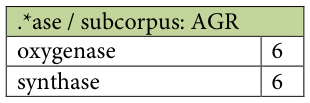
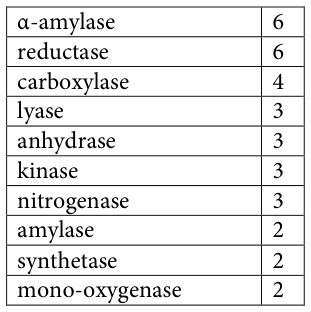
Table 42. Most frequent enzymes in the AGRONOMY subcorpus (filtered list of words ending in -ase)
The term RuBisCO is the abbreviation of ribulose‐bisphosphate carboxylase/oxygenase. It belongs to the ENZYME category of LYASES and participates in the frame of the CALVIN CYCLE OF PHOTOSYNTHESIS. Reductase is a generic name for all the enzymes that catalyze a reduction reactionIts corresponding concept (REDUCTASE) is thus also superordinate hyperversatile. and in the AGRONOMY subcorpus, its most common type is APS reductase, which takes part in the frame of SULFUR METABOLISM.
For its part, DIOXIDE is also a superordinate hyperversatile concept, but in contrast to enzyme, dioxide is always preceded by a modifier, e.g.: carbon dioxide, sulfur dioxide, nitrogen dioxide. In this case, the contextualized definition of DIOXIDE for each domain would include its necessary characteristics (“oxide that contains two atoms of oxygen in each molecule”) and a reference to its main subtypes in the domain according to corpus evidenceSince DIOXIDE is a chemical compound, in order to determine the most relevant subtypes, it is necessary to generate a wordlist of the terms containing the string “O2”, as well as the modifier word-sketch of the term dioxide..
5.3.3. Artifactual concepts
In this group of concepts, we have included those whose referents are artifacts:
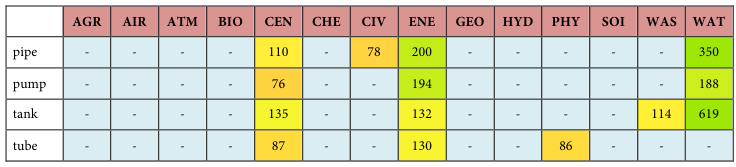
Table 43. Terms whose corresponding concepts can be categorized as ARTIFACTS
All the examples offered by Cruse for microsenses were artifacts (knife, ball, card). However, none of the artifactual concepts analyzed in this work gave rise to subconceptualizations with respect to our domainsIt is probable, though, that they give rise to subconceptualizations in very restricted contexts.. These concepts only manifest perspectives and are superordinate hyperversatiles in their respective domains. For instance, the three first results of the modifier word-sketches for tank in its different contextual domains are the following:
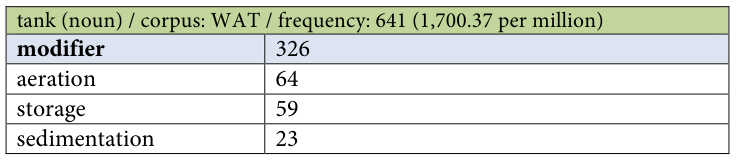
Table 44. Modifier word-sketch for the term tank in the WATER TREATMENT AND SUPPLY subcorpus
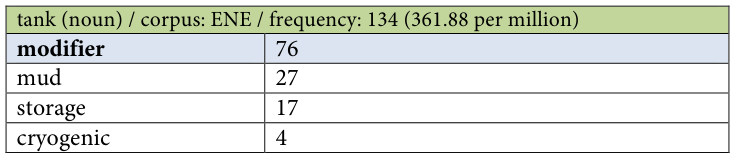
Table 45. Modifier word-sketch for the term tank in the ENERGY ENGINEERING subcorpus
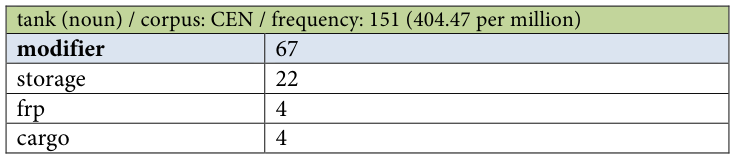
Table 46. Modifier word-sketch for the term tank in the CHEMICAL ENGINEERING subcorpus
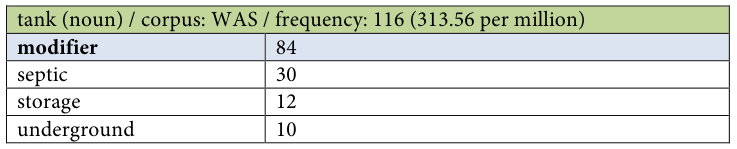
Table 47. Modifier word-sketch for the term tank in the WASTE MANAGEMENT subcorpus
As can be observed, each contextual domain has an array of representative types of TANK, although STORAGE TANK, a tank with the specific function of storing a fluid, appears in all of them. For instance, in WATER TREATMENT AND SUPPLY, there is also AERATION TANK (a tank where air is injected into water) and SEDIMENTATION TANK (a tank where suspended solids in water are allowed to settle so that they can be removed) (see Table 44). Tanks in WATER TREATMENT AND SUPPLY are mainly used to hold water, but they can also hold other substances needed to treat water or the by-products of the treatment. There is not a characteristic so prototypical in any of its domains that it modifies the extension of the concept. As a consequence, the necessary characteristics of TANK in WATER TREATMENT AND SUPPLY are not modified with respect to the general environmental conceptualization and TANK participates in a broad range of frames through its subordinate concepts.
5.3.4. Functional concepts
In this group, we have included those having a function either in natural or artificial processes as a necessary characteristic. All of them, except for FERTILIZER, give rise to subconceptualizations:
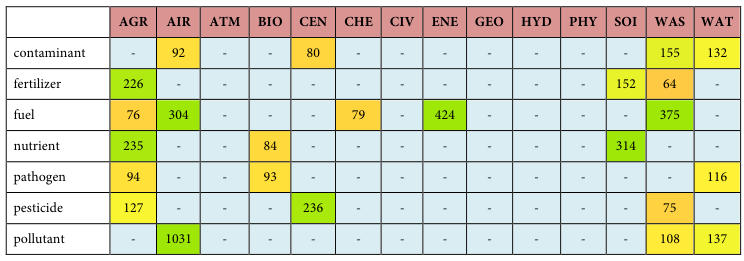
Table 48. Terms whose corresponding concepts are functional
CONTAMINANT, NUTRIENT, PATHOGEN, and POLLUTANT generate subconceptualizations in some of their contextual domains. It follows that their extension is different in those domains with respect to the general environmental premeaning. Table 49 shows a summary of the domain- specific contextual variation of these concepts.
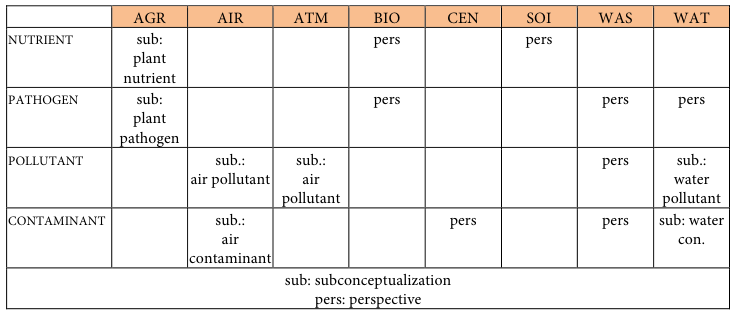
Table 49. Summary of the domain-specific contextual variation of NUTRIENT, PATHOGEN, POLLUTANT, and CONTAMINANT
NUTRIENT in its general environmental conceptualization could be said to have the necessary characteristic of being a substance that provides nourishment to a living organism. This characteristic of NUTRIENT is restricted to the provision of nourishment to plants in AGRONOMY, thus modifying the extension of the category. However, in the case of SOIL SCIENCES, although nutrient usually refers to PLANT NUTRIENT, it is also applied to other types of NUTRIENT (such as ANIMAL NUTRIENT, or MICROORGANISM NUTRIENT). Therefore, given that the characteristic of the provision of nourishment to plants is not strong enough to become necessary, NUTRIENT has the same extension in SOIL SCIENCES as in the general environmental premeaning.
NUTRIENT does not have different superordinate concepts in AGRONOMY with respect to its other contextual domains and the general environmental conceptualization. NUTRIENT is a superordinate-level concept in all of the analyzed domains, and it follows that its only possible superordinate concept is SUBSTANCE. The situation is similar for CONTAMINANT, PATHOGEN, and POLLUTANT, which also give rise to subconceptualizations and do not show different superordinate concepts depending on the domain.
The subconceptualizations of these concepts have a lexicalized term associated, and their extension corresponds to a full-fledged concept in EcoLexicon. For instance, the subconceptualization of CONTAMINANT in AIR QUALITY MANAGEMENT corresponds to AIR CONTAMINANT. As a consequence, the definition of contaminant in AIR QUALITY MANAGEMENT will consist of a hyperlink to the definition of AIR CONTAMINANT contextualized in that domain.
The kind of subconceptualization that functional concepts show are associated with their nature of quasi-predicates (Mel’čuk and Polguère 2008; Polguère 2012). While the concepts referring to events and attributes are predicative because they convey a fact and, therefore, need arguments, the concepts denoting entities are not predicative because they can be conceived without reference to arguments: WIND, OXYGEN, PLANET. However, quasi-predicate concepts are entity concepts that need arguments:
Comme le terme l’indique, un quasi-prédicat n’est pas un prédicat au sens strict, car il ne satisfait pas la propriété sémantique définitoire des prédicats: celle de dénoter un fait. Cependant, l’entité dénotée par un quasi-prédicat est particulière, en ce sens qu’elle est définie plutôt par son implication dans un fait que par ses propriétés intrinsèques; à cause de cela, un quasi-prédicat contrôle des positions actancielles (Mel’čuk and Polguère 2008: 6).
In DicoEnviro, examples of quasi-predicates are encoded with their argument structure:
ej. 49 PASSENGER: PATIENT(user) is a ~ of INSTRUMENT(vehicle)
ej. 50 DEPOSIT: ~ of PATIENT(substance)
ej. 51 DRIVER: AGENT(user) is a ~ of PATIENT(vehicle)
In our opinion, the specification of the arguments of a quasi-predicate is in many cases subjective and context-sensitive. Consequently, the arguments of CONTAMINANT, NUTRIENT, PATHOGEN, and POLLUTANT could be the following:
- CONTAMINANT => CONTAMINANT of x(ENVIRONMENT)
- NUTRIENT => NUTRIENT for x(LIVING ORGANISM)
- PATHOGEN => PATHOGEN to x(LIVING ORGANISM)
- POLLUTANT => POLLUTANT of x(ENVIRONMENT)
Although PATHOGEN is an entity, it also carries an inner predicate that could be expressed as follows: “PATHOGEN causes disease in X”. The X in that inner predicate corresponds to the argument of PATHOGEN (PATHOGEN TO X). This inner predicate is a necessary characteristic of the concept, and the context may specify it further. Depending on the value of X, the extension of the concept changes. If, in a given domain’s premeaning, the value of X is different from the value of X in the general environmental premeaning, then there is a subconceptualization. For example, in AGRONOMY, the argument of PATHOGEN is by default PLANT in contrast to the general environmental premeaning, where it is a LIVING ORGANISM. In BIOLOGY, it is also a LIVING ORGANISM (therefore, there is no subconceptualization), but if we only consider ZOOLOGY, the argument would be ANIMAL and then it would be a subconceptualization.
PESTICIDE and FUEL
PESTICIDE and FUEL are more complex cases of domain-specific subconceptualizations. The main characteristic of PESTICIDE is that the extension of its subconceptualization in AGRONOMY is at the same time more general and more restrictive. As for FUEL, the extension of its subconceptualization in AGRONOMY corresponds to that of a concept that is not relevant in that domain, since its lexicalization is not found in the corresponding subcorpus.
PESTICIDE is preconceptualized in the general environmental domain as any AGENT used to repel, kill or control pests. However, in AGRONOMY, its subconceptualization is more specific with respect to certain characteristics, but also more extense concerning others. The premeaning of PESTICIDE in AGRONOMY specifies that it refers to an agent used to repel, kill or control pests in plants or plant products. Therefore, in AGRONOMY, the extension of PESTICIDE does not include those pesticides used, for instance, to protect human from pests. On the other hand, it prototypically includes other type of products such as defoliants or desiccants, which help crops grow or offers them protection.
The term plant protection product lexicalizes this subconceptualization, even though it does not include the term pesticide. This term is only a synonym for pesticide in AGRONOMY. Currently, EcoLexicon does not allow the inclusion of context-dependent synonyms, but this will be implemented in the future.
As for FUEL, its corresponding term appears (with more than 64 occurrences) in five domains in our corpus: AGRONOMY, AIR QUALITY MANAGEMENT, CHEMISTRY, ENERGY ENGINEERING, and WASTE MANAGEMENT. The general environmental premeaning of FUEL can be roughly glossed as a substance from which energy can be obtained by chemical or nuclear reaction. It is precisely the type of reaction that produces a subconceptualization in AGRONOMY, which is the only domain where NUCLEAR FUEL is not pertinent. In AGRONOMY, the extension of FUEL only includes those from which energy can be obtained through a chemical reaction (normally, combustion). They are relevant because agricultural machinery needs fuel to function, and also because certain crops can be used to produce biofuel. CHEMICAL FUEL is not a relevant concept in AGRONOMY because the term chemical fuel does not appear in the AGRONOMY subcorpus. As a consequence, the AGRONOMY contextualized definition of FUEL is not replaced by a hyperlink to the definition of CHEMICAL FUEL, as is the case of POLLUTANT in AIR QUALITY MANAGEMENT with AIR POLLUTANT. The definition of FUEL in AGRONOMY represents as necessary (instead of simply prototypical) the characteristic that gives rise to the context-specific change of extension (in this case, the type of reaction):
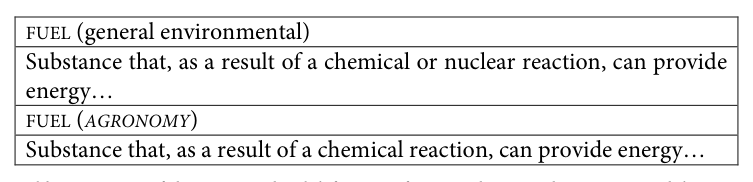
Table 50. Extract of the contextualized definition of FUEL in the general environmental domain and AGRONOMY
If FUEL in AGRONOMY was a simple perspective without a subconceptualization, the trait “as a result of a chemical reaction” would be represented as prototypical, for instance, by adding an adverb such as normally or usually: “normally as a result of a chemical reaction”.
Therefore, in cases like fuel, where the extension of the subconceptualization corresponds to a concept that is not relevant in that domain the contextualized definition represents as necessary a characteristic that is a prototypical or optional trait in the general environmental definition. This is also the case for subconceptualizations that do not correspond to another independent concept.
In the other domains, both chemical and nuclear fuels are relevant. For instance, in WASTE MANAGEMENT, FUEL activates the frame BIOFUEL PRODUCTION FROM WASTE, where only chemical fuels are relevant. It also invokes the frame NUCLEAR WASTE MANAGEMENT, where USED NUCLEAR FUEL is categorized as a RADIOACTIVE WASTE that needs to be safely disposed of.
If we had divided the ENERGY ENGINEERING domain, NUCLEAR FUEL would be a subconceptualization of FUEL in a hypothetical subdomain of NUCLEAR ENERGY. However, throughout ENERGY ENGINEERING, both CHEMICAL FUEL and NUCLEAR FUEL are relevant subtypes of FUEL. Therefore, the extension of the ENERGY ENGINEERING premeaning is similar.
FERTILIZER
FERTILIZER is the only concept in this group that did not give rise to subconceptualizations because its extensions are not altered in its respective domains. FERTILIZER can also be regarded as a quasi-predicate. However, in the three domains in which it appears (AGRONOMY, SOIL SCIENCES, and WASTE MANAGEMENT), its Y argument is always SOIL (A X(HUMAN BEING) uses a FERTILIZER to render Y(SOIL) more fertile). No other characteristic of the concept gives rise to subconceptualizations. Therefore, it only undergoes perspectivization in its domains.
5.3.5. Other concepts
In this section, we analyze the rest of the concepts on our working list:
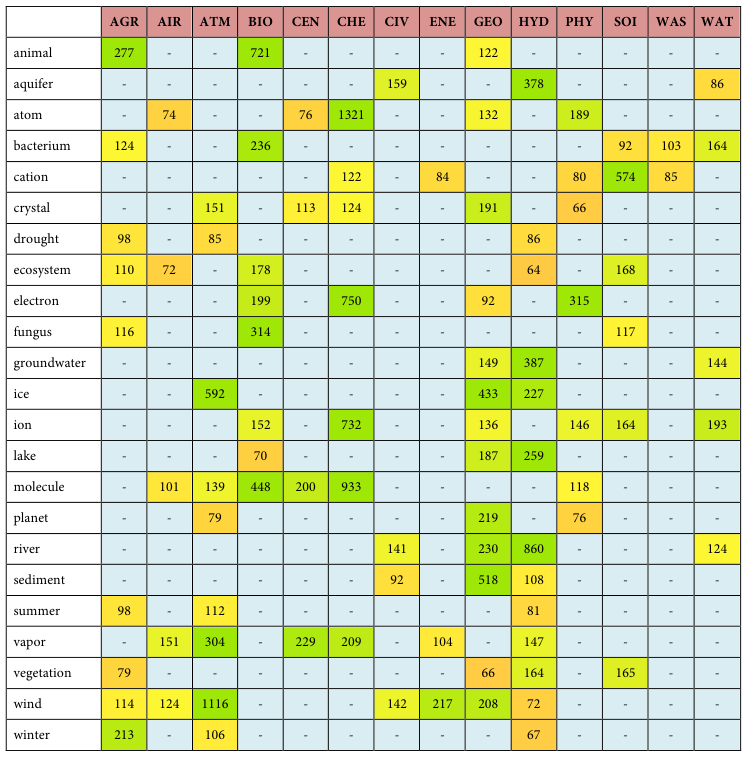
Table 51. Remaining terms in the working list
Concepts with subconceptualizations
There are five concepts that give rise to subconceptualizations in their domains: VAPOR, CRYSTAL, SUMMER, WINTER, and DROUGHT.
VAPOR and CRYSTAL both have subconceptualizations linked to their quasi-predicate arguments. VAPOR can be roughly defined as the gas of a substance that is at a state below its critical temperature. Its argument structure is VAPOR of (X). In all of its domains except for HYDROLOGY and ATMOSPHERIC SCIENCES, the value of X is SUBSTANCE by default. In HYDROLOGY and ATMOSPHERIC SCIENCES, it is WATER, thus generating a subconceptualization.
CRYSTAL is also a quasi-predicate whose argument expresses the substance that composes it: CRYSTAL of X. This gives rise to a subconceptualization in ATMOSPHERIC SCIENCES, for which the value of X is ICE. In the other domains, since it is preconceptualized as being composed of many different substances, the extension is the same as in the general environmental premeaning.
SUMMER, WINTER, and DROUGHT all refer to time periods. Their referents are also vague. Different domains determine differently the start and the end of those periods. This is the reason why they generate subconceptualizations.
The case of WINTER is similar to SUMMER, which was discussed in §5.2.3.4. As for DROUGHT, experts in different environmental domains have already remarked that it is a concept that has different definitions, depending on the domain (Wilhite and Glantz 1985; Mishra and Singh 2010). While DROUGHT can be roughly defined as a period of time with a deficiency of precipitation, only the domain determines how long and how severe the precipitation deficiency must be for it to be considered a DROUGHT. Droughts can have various effects, and each domain focuses on different ones to delimit the extension of the concept.
In our corpus, the term drought had over 64 occurrences in AGRONOMY, ATMOSPHERIC SCIENCES, and HYDROLOGY. This matched the classification of definitions proposed by Wilhite and Glantz (1985), which also includes a fourth type of DROUGHT, namely, socio-economic droughtThe socio-economic view of DROUGHT defines it as having consequences on the socio- economic activities that depend on water supply (Wilhite and Glantz 1985: 115)..
ATMOSPHERIC SCIENCES only takes into account the duration and severity of the precipitation deficiency in comparison to climate records. However, a DROUGHT in AGRONOMY is based on the effects that the deficiency of precipitation has on agricultural activities. For its part, HYDROLOGY restricts its premeaning of DROUGHT to the cases where the deficiency of precipitation affects the hydrological system, especially river basins.
The general environmental definition would encompass all the subconceptualizations of DROUGHT, including socio-economic drought. The domain definitions of DROUGHT would describe their extension and the perspective taken by the domain.
Concepts with perspectives
Among the concepts with perspectives, PLANET is an interesting example. Although it did not produce subconceptualizations, there were occurrences in the corpus where planet without any modifier referred to EARTH (this also happens in general language). Some concordances from our corpus are shown in Table 52.

Table 52. Concordances of the string “the planet” in the ATMOSPHERIC SCIENCES, PHYSICS and GEOLOGY subcorpora
Since the Earth is the planet where we live, if the term is used with a definite article (“the planet”) without any contextual cue, this activates the concept EARTH. However, this is not a case of autohyponymic polysemy. It is simply a way of denoting a referent by using its hyperonym, such as when there is a dog in the room, and someone says “the animal”.
Most of the concepts in this last group are hyperversatile in most of their domains. Relevant examples include all the concepts that referred to living organisms (ANIMAL, BACTERIUM, FUNGUS, and VEGETATION). The main reason for this is that all of them are superordinate-level concepts. Therefore, they have many subordinate concepts that participate in many different frames.
Although a larger sample would be necessary, it seems that hyperversatility is a very common phenomenon. In fact, in our opinion, this is the reason that FrameNet (§2.1.2.2) lacks a consistent representation of certain types of lexical unit, such as those denoting artifacts.
5.4. FLEXIBLE DEFINITIONS
5.4.1. A concept with subconceptualizations: POLLUTANT
POLLUTANT, as reflected in the results of the terminological extraction, is relevant in the domains of AIR QUALITY MANAGEMENT, WASTE MANAGEMENT and WATER TREATMENT AND SUPPLY (Table 53). The following sections describe the process of extracting the knowledge associated with this concept, how contextual variation affects its domain-specific construals, and how it can then be then represented in a flexible terminological definition.

Table 53. Frequency of the term pollutant (noun) in the corresponding contextual domains according to TermoStat
and the third (which used data from the first stage) focused on genus choice. Finally, our proposal of a flexible definition for POLLUTANT is presented along with an explanation of how it was created.
The first step was the analysis of definitions from other resources because this was the fastest of obtaining an overall understanding of the concept. However, as shall be seen, these definitions tended to fall short in their reflection of contextual variation.
We then continued with the analysis of contextonyms because it was the most efficient way to identify how each domain construed a given concept and the other concepts activated along with it. Although the study of the contextonyms of a term in different domains was a longer process than consulting definitions from other resources, it provided a better picture of contextual variation, and made it easier to select context-specific differentiae.
Finally, hyperonym candidates were analyzed, and the genus for each contextual domain was chosen. This was the final step before writing the definitions because the choice of genus had to be in accordance with the frame or frames activated by the concept in its respective contextual domains. The choice of genus was thus the product of an in-depth understanding of the concept. This could only be achieved after the previous stages had been completed.
5.4.1.1. Definitions of POLLUTANT from other resources
A total of 50 specialized definitions of pollutant were collected from different terminological sources (see Annex 3 for the complete list of definitions). Only those definitions of the term pollutant without any modifier were included in the analysis. The definitions were classified according to their domain. No definitions for pollutant were found in AIR QUALITY MANAGEMENT resources. Two of the definitions belonged to WASTE MANAGEMENT, 17 to WATER TREATMENT AND SUPPLY, and 31 belonged to the general environmental domain. We considered that a definition belonged to the general environmental domain if it was related to another environmental domain other than AIR QUALITY MANAGEMENT, WASTE MANAGEMENT, and WATER TREATMENT AND SUPPLY or if it encompassed the whole environmental domain.
The following tables summarize the conceptual characteristics featured by the definitions analyzed according to the domain. In the tables, we used a wording similar to the one in the definitions to reflect the different viewpoints. As a consequence, there are certain overlaps.
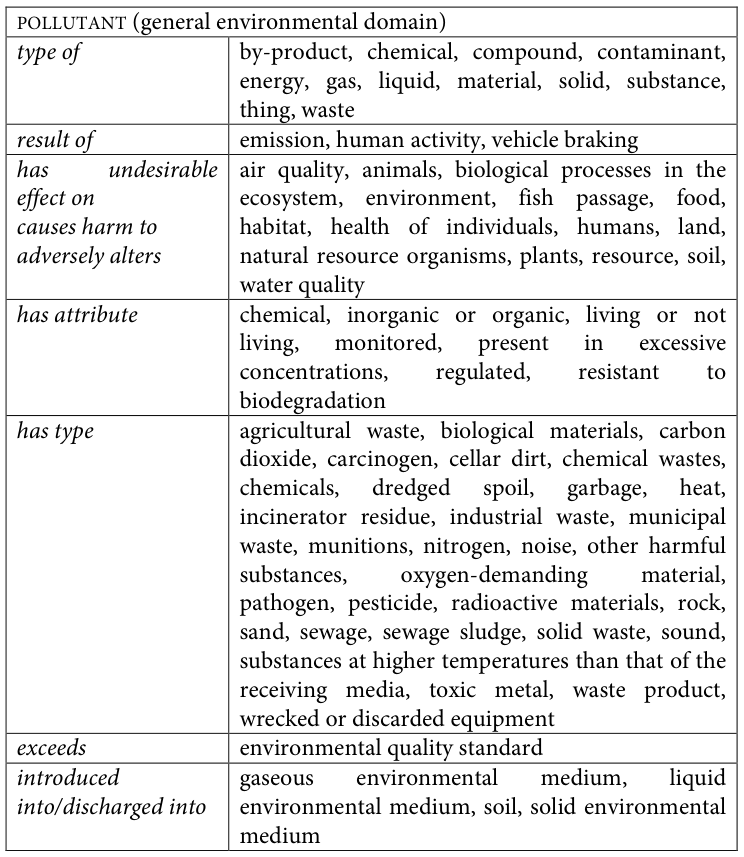
Table 54. Characteristics of POLLUTANT represented in the definitions from other resources that belong to other environmental domains or the whole environmental domain
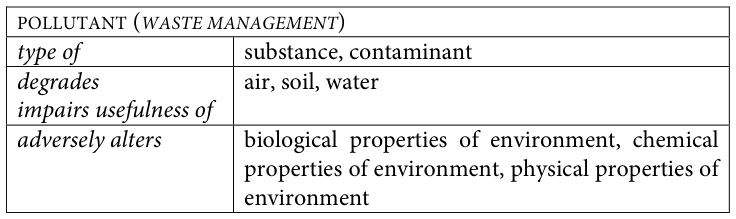
Table 55. Characteristics of POLLUTANT represented in the definitions from other resources that belong to the WASTE MANAGEMENT domain
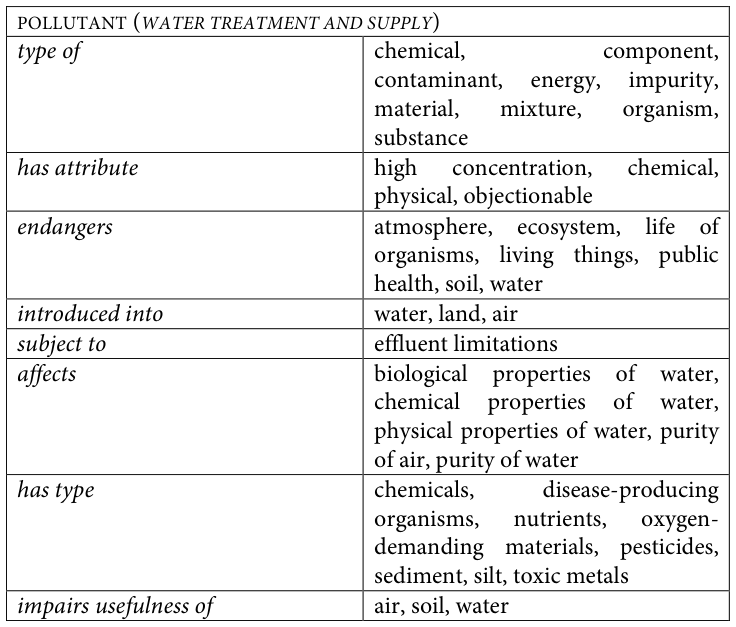
Table 56. Characteristics of POLLUTANT represented in the definitions from other resources that belong to the WATER TREATMENT AND SUPPLY domain
As can be seen, there is consensus that a POLLUTANT is an entity with an undesirable effect on the environment or human beings. This effect is due to its being where it should not be or to its having an unacceptably high concentration in a certain medium or at a certain location. Some definitions indicate as well that a POLLUTANT is normally the result of human activity.
Certain definitions provide more detail on the damage that a POLLUTANT may cause depending on what it affects. Moreover, a small number of definitions underline that POLLUTANTS tend to be regulated by standards. It is usual that examples of the extension of the category are also included in the definitions.
According to the definitions, the extension of POLLUTANT includes not only SUBSTANCES (e.g., CARBON DIOXIDE, PESTICIDE, TOXIC METAL), but also LIVING BEINGS, HEAT, and SOUND. Additionally, some definitions include all sorts of WASTES as POLLUTANTS. However, this is not accurate because WASTES contain POLLUTANTS, but are not POLLUTANTS per se.
The domain-specific definitions do not help determine the specificities of the premeaning in contextual domains. For instance, in WASTE MANAGEMENT, they make no reference to the role of the concept in the domain. As for WATER TREATMENT AND SUPPLY, only three out of the 17 analyzed definitions limited the extension of POLLUTANT to WATER POLLUTANT.
5.4.1.2. Contextonyms of pollutant
The analysis of contextonyms provides an insight into the role of a concept in a given domain. We analyzed the first 100 contextonyms of pollutant in each of its contextual domains as well as the general environmental contextonyms (the contextonyms of pollutant in the whole MULTI corpus). The full lists with the frequency of each contextonym in each contextual domain and the general environmental domain are in Annex 4.
In order to visualize the results more clearly and be able to compare between contextual domains, we represented the first 50 contextonyms in each contextual domain in a Venn diagram (Figure 30)In Figure 30, since the objective was to compare between the contextual domains, the general environmental contextonyms were not included. In Figure 31 we compared the general environmental contextonyms with the ones from the contextual domains.. As can be seen, among the terms shared by AIR QUALITY MANAGEMENT, WASTE MANAGEMENT, and WATER TREATMENT AND SUPPLY are concentration, quality, reduce, and source. This shows that, in all the contextual domains, (i) the concentration and source of pollutants are important parameters; (ii) pollutants affect the quality of the medium in which they are introduced; and (iii) efforts are made to reduce the amount of pollutants in the environment. The other shared contextonyms are a derivative that indicates the process in which POLLUTANT participates (pollution), and terms that do not convey a definite relation in their corresponding concordances (include, system, use). For instance, system, since it is a very versatile term, appears in the contextonym concordances as part of diverse complex terms such as sewer system, aquatic system, permit system, or gastrointestinal system. Thus, it is not possible to determine a clear relation
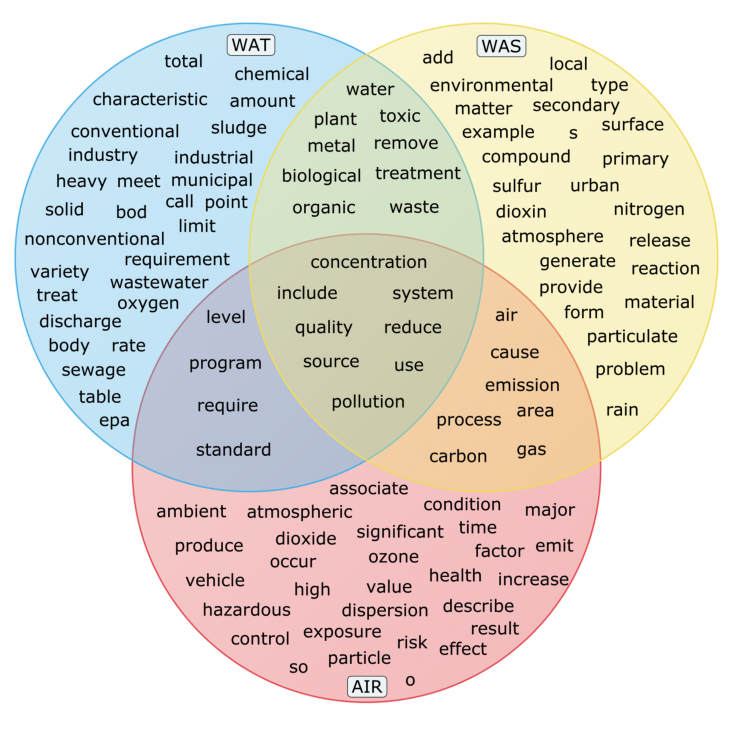
between POLLUTANT and SYSTEM.
The following sections describe what the contextonyms extracted from each contextual domain and the general environmental domain show about how POLLUTANT is construed contextually.
5.4.1.2.1. AIR QUALITY MANAGEMENT contextonyms of pollutant
The subconceptualization of POLLUTANT as an AIR POLLUTANT in AIR
QUALITY MANAGEMENT becomes evident in view of its contextonym list. Terms like air, atmospheric, and atmosphere rank high on the list. Neither water nor soil appear. In the following paragraphs, we outline the information that according to the pollutant contextonyms in AIR QUALITY MANAGEMENT are relevant to its construal in this contextual domain.
Atmospheric pollution (also known as air pollution) is due to the emission of pollutants from very different sources into ambient air (for instance, industrial activities or the use of hydrocarbon fuels in vehicles). Many substances considered pollutants are already present in the atmosphere, but it is their high concentration in relation to natural levels and their adverse effects what causes them to be categorized as pollutants. Natural sources (such as volcanoes and the ocean) also contribute to air pollution. However, there are no terms related to natural pollution in the first 100 contextonyms, which indicates that human activities are the prototypical source of air pollution.
Although AIR QUALITY MANAGEMENT studies all the effects that air pollution has on the environment, as revealed in the contextonym list, one of the most important is the associated risk to human health of pollution exposure. This domain also focuses on the control and reduction of air pollution, where air pollution dispersion is a major factor.
Major air pollutants (most of which are in the contextonym list) include tropospheric ozone (O3), particle pollution, carbon monoxide (CO), nitrogen oxides, sulfur dioxide (SO2) and lead (Pb). Greenhouse gasses, such as carbon dioxide (CO2) or methane (CH4) are also common air pollutants. Those air pollutants that cause severe health effects (such as cancer) or have environmental impact are categorized as hazardous air pollutants (such as benzene or mercury). The emission of pollutants is regulated by air quality standards.
In the light of the contextonym analysis, POLLUTANT is subconceptualized as AIR POLLUTANT and takes part in the AIR POLLUTION frame. This is a generic frame that has many subframes since there are a great variety of air pollutants, and their source and effects are very diverse. However, in the definition of AIR POLLUTANT, it is possible to provide a summary of the most important aspects of the general frame of air pollution, which would include the information outlined above.
5.4.1.2.2. WASTE MANAGEMENT contextonyms of pollutant
Air and water rank high on the list of contextonyms. Soil and land are present as well in a lower position on the list. This indicates that the extension of POLLUTANT is not limited in this contextual domain as far as the patient of the process of pollution is concerned. Below, we present the information that, according to the 100 first pollutant contextonyms in WASTE MANAGEMENT, are relevant to its construal in this contextual domain.
Among the main objectives of WASTE MANAGEMENT is to avoid waste to become pollutants or reduce its effect. However, many waste management treatments cause pollution such as incineration or landfill use. Incineration, which is used to deal with organic waste materials, emits pollutants to the atmosphere such as nitrogen oxide, carbon dioxide, sulfur dioxide, dioxins and particulate matter (which includes heavy metals). The use of landfills also releases pollutants. On the one hand, landfills may emit gasses such as methane. On the other hand, pollutants may also leach from the landfill and pollute the soil and groundwater, being rain one of the primary causes. To a lesser extent, composting can also pollute the environment. It is worth noting that only incineration appears in the first 100 contextonyms. This was reflected in the corresponding contextualized definition.
The terms primary and secondary are also contextonyms of pollutant in this contextual domain. They point to the distinction between those air pollutants that are emitted directly from a source (primary pollutants) and those that result from some reaction after emission. The reason why these contextonyms are in the first-100-contextonym list in WASTE MANAGEMENT though not in AIR QUALITY MANAGEMENT is attributable to the size of the corpus. In the WASTE MANAGEMENT subcorpus, there were only 112 occurrences of pollutant and a portion of one of the books on WASTE MANAGEMENT included in the corpus made use of that categorization. Therefore, the terms primary and secondary were overrepresented in the WASTE MANAGEMENT contextonym list.
In view of the contextonyms of pollutant in WASTE MANAGEMENT, it became evident that POLLUTANT participates in many different frames in this contextual domain. Therefore, it can be considered hyperversatile. However, all of these frames tend to conceptualize POLLUTANTS as results from waste disposal or waste management processes. This raises the question of whether POLLUTANT in WASTE MANAGEMENT is a subconceptualization instead of a perspective. In other words, is the extension of POLLUTANT constrained to only those members of the category resulting from waste disposal or waste management processes?
As stated in §5.2.3, the distinction between subconceptualization and perspective is fuzzy, and this is an example. In our opinion, this is a case of perspectivization because other types of pollutants different from waste- related pollutants are also probably activated when the concept POLLUTANT is employed in this contextual domain. Consequently, the characteristic that POLLUTANT can be the result of waste-related processes has prototypical status (not necessary), and, therefore, does not limit the extension of the concept.
5.4.1.2.3. WATER TREATMENT AND SUPPLY contextonyms of pollutant
The contextonyms of pollutant in WATER TREATMENT AND SUPPLY reveal that the extension of the concept in this domain is more limited than the one in the general environmental domain. POLLUTANT gives rise to a subconceptualization that coincides with the extension of the concept WATER POLLUTANT. In what follows, we outline the information that, based on the list of contextonyms in WATER TREATMENT AND SUPPLY, is relevant to the premeaning of POLLUTANT in this contextual domain.
Wastewater treatment plants have the function of making wastewater (for instance, sewage or industrial wastewater) suitable for discharge into the water cycle or for reuse. Among other things, this entails, the removal of pollutants.
Water pollution can be divided into two types depending on its sourceThis categorization is also applicable to air pollution, but, according to our corpus, it is more frequently used for water pollution.. The first type is non-point-source pollution, which comes from many diffuse sources. This pollution affects water normally due to runoff that carries away pollutants. Point-source pollution has its origin from a single discrete, identifiable source that discharges pollutants into a water body such as industrial facilities or wastewater treatment plants. In most countries, discharge water needs to meet quality standards that limit the amount of pollutants. The disposal of sludge (the solid waste resulting from water treatment) is also required to comply with pollutant concentration limits.
Because of the origin of the texts, certain terms that point to the categorization of water pollutants in the United States appear in the contextonym list. In the USA, the Environmental Protection Agency (EPA) classifies water pollutants into three types: priority, conventional, and nonconventional:
- Priority pollutants are 126 chemical toxic pollutants for which the EPA has developed analytical test methods. Most of them are organic compounds. None of the priority pollutants are among the first 100 contextonyms of pollutant in this domain, but the terms heavy and metal do appear. Heavy metals (such as mercury and lead) are priority pollutants.
- Conventional water pollutants are those that an American municipal wastewater plant can remove. As a consequence, this category includes common chemical and biological pollutants in municipal wastewater: biochemical-oxygen-demanding (BOD) substances, total suspended solids, pH-altering substances, fecal coliform bacteria, and oil and grease.
- Nonconventional pollutants include any other water pollutant not included in the other two categories, such as ammonia, nitrogen or phosphorus.
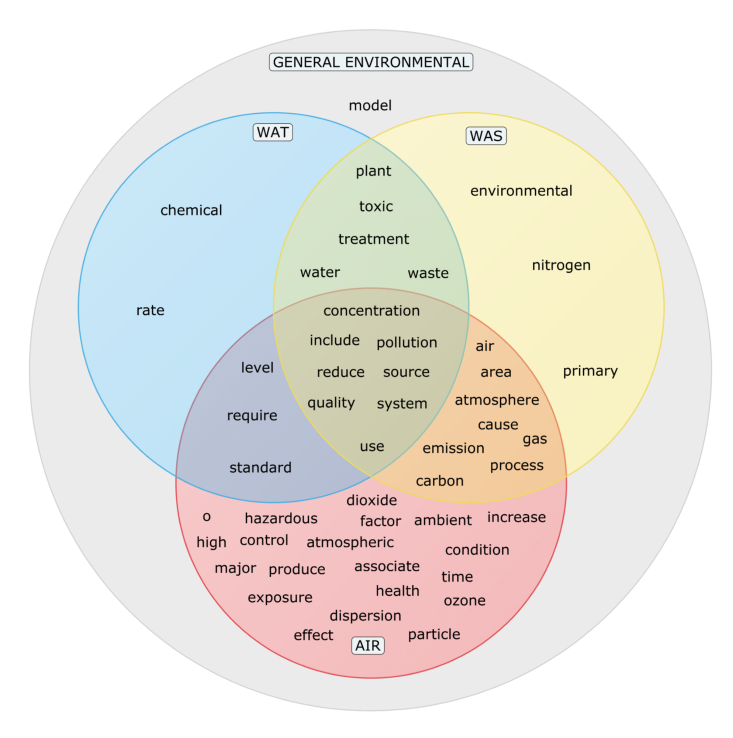
Since POLLUTANT is construed as a subconceptualization in WATER
TREATMENT AND SUPPLY, the contextualized definition of POLLUTANT for this domain would forward to the contextualized definition of WATER POLLUTANT for the same contextual domain. In that definition, WATER POLLUTANT would be represented as a participant in a general frame that could receive the name of WATER POLLUTION. This frame would have many subframes, for instance, NON-POINT-SOURCE WATER POLLUTION and POINT- SOURCE WATER POLLUTION, which would in its turn have many other subframes.
5.4.1.2.4. General environmental contextonyms of pollutant
As part of the analysis of the 100 first general environmental contextonyms of pollutant (i.e., the contextonyms of pollutant in the MULTI corpus), we compared them with the contextonyms of POLLUTANT in its contextual domains. Our results show that 98 of the general environmental contextonyms were also contextonyms in the contextual domains. Only method and fuel were not contextonyms in the contextual domains. Method is a versatile term, and no clear relation between POLLUTANT and METHOD could be determined. Fuel refers to the emission of air pollutants by the combustion of fossil fuels, which is one of the main sources of air pollution (it is the 109th contextonym in AIR QUALITY MANAGEMENT).
To create the visual representation in Figure 31, we compared the 50 first contextonyms. As can be seen, the AIR QUALITY MANAGEMENT contextonyms are the most coincident with the general environmental ones, which indicates the prototypicality of AIR POLLUTION in comparison to other kinds of POLLUTION. The only contextonym not shared with its contextual domains is modelSince model is the 77th AIR QUALITY MANAGEMENT contextonym, it was not among the terms that were not shared between the general environmental contextonyms and those of the contextual domains., a term that did not convey a clear relation in the concordances because it made reference to very different kinds of model.
In conclusion, the general environmental contextonyms show that the general environmental premeaning encompasses parts of all the contextual domains, although the characteristics related to AIR QUALITY MANAGEMENT are slightly more relevant.
5.4.1.3. Extraction of superordinate concepts and choice of genera for POLLUTANT
We extracted superordinate concept candidates from the definitions of other resources (the same definitions analyzed in §5.4.1.1), and from corpora by means of hypernymic knowledge patterns.
As explained in §3.6.3, the genera of definitions in EcoLexicon coincide with the superordinate concepts of the definiendum in the knowledge base. The general environmental definition corresponds to the general environmental superordinate, and each contextualized definition’s genus is the corresponding contextual preferential superordinate concept. In order to determine the genus of each definition, we extracted superordinate candidates.
However, the superordinate candidates extracted from the definitions of other resources and corpora are only to be used as a guide, since the coherence of the conceptual hierarchies must take precedence. Moreover, if possible, the most prototypical frame invoked by the concept should be reflected in the genus.
This stage only affects the definition of POLLUTANT in the general environmental domain and WASTE MANAGEMENT, since both the definitions of AIR POLLUTANT and WATER POLLUTANT take POLLUTANT as a superordinate concept. For this reason, the genus of the definitions collected for these two domains were counted along with general environmental definitions (which include definitions from other domains or the whole environmental domain). The result from the extraction from the definitions of other resources organized by headword is represented in Table 57:
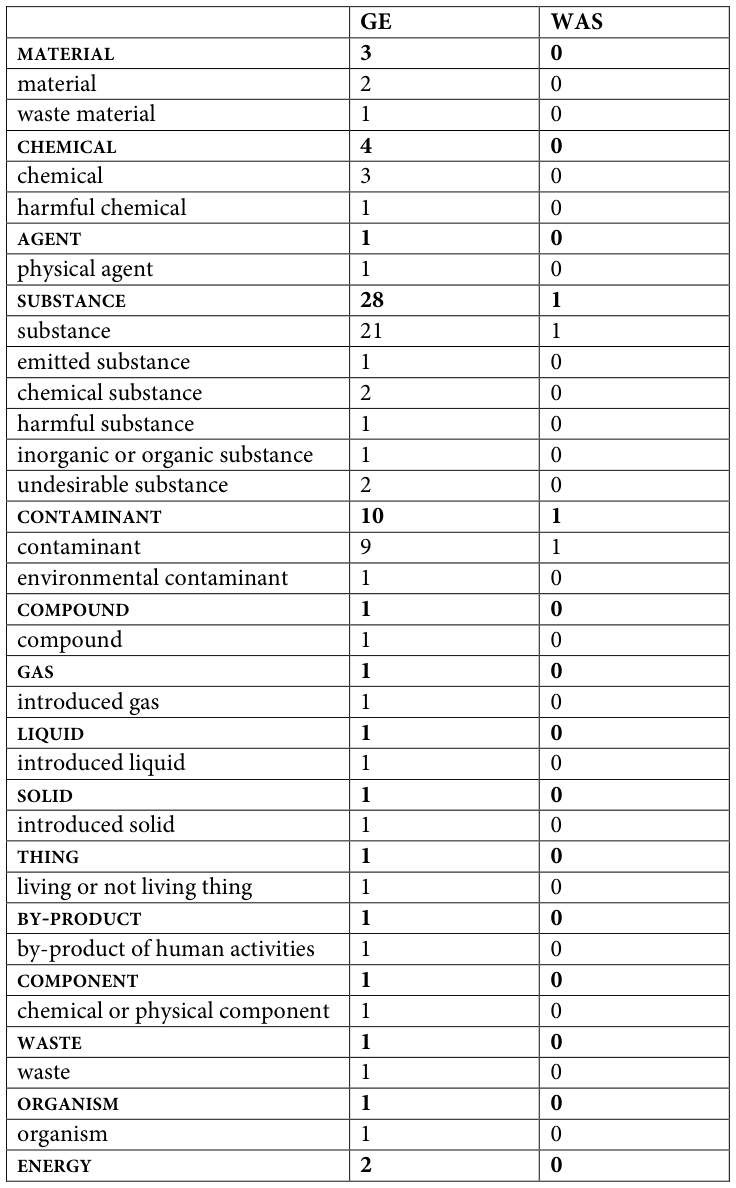
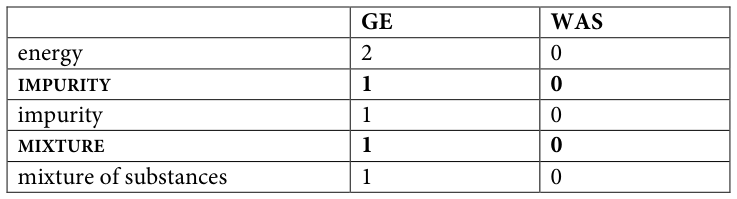
Table 57. Superordinate concept candidates of POLLUTANT extracted from the definitions of other resources
As can be seen, the superordinate SUBSTANCE is the most common in the environmental definitions. In WASTE MANAGEMENT, there are only two superordinate concept candidates: SUBSTANCE and CONTAMINANT.
This list of superordinate concepts was complemented with those extracted from the PANACEA corpus since no hypernymic knowledge- rich contexts for pollutant were extracted from the MULTI corpus. We only considered those cases where pollutant was not modifying or being modified by another lexical unit. We obtained a total of seven superordinate concepts candidates from the PANACEA corpus. Table 58 shows the concordances and Table 59 shows the results.

Table 58. Hypernymic knowledge-rich contexts for the lemma pollutant (noun) in the PANACEA corpus
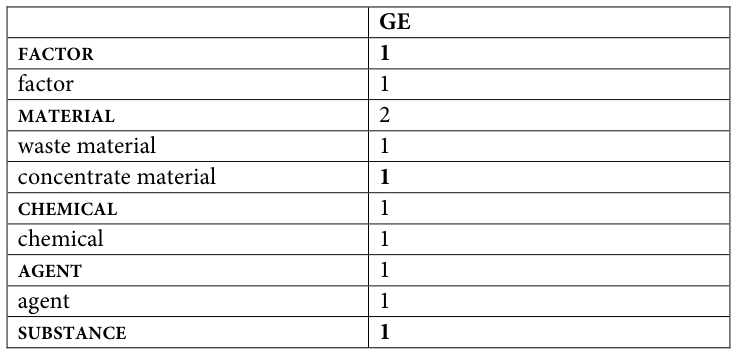

Table 59. Superordinate concept candidates of POLLUTANT extracted from corpora
Of the list of superordinate concepts extracted from the corpus, only two candidates were not present on the list extracted from the definitions: factor, and condition.
The combined results of the definitions of other resources and of hypernymic knowledge-rich contexts from corpora are shown in the following table (for the sake of clarity, only headwords are taken into account):
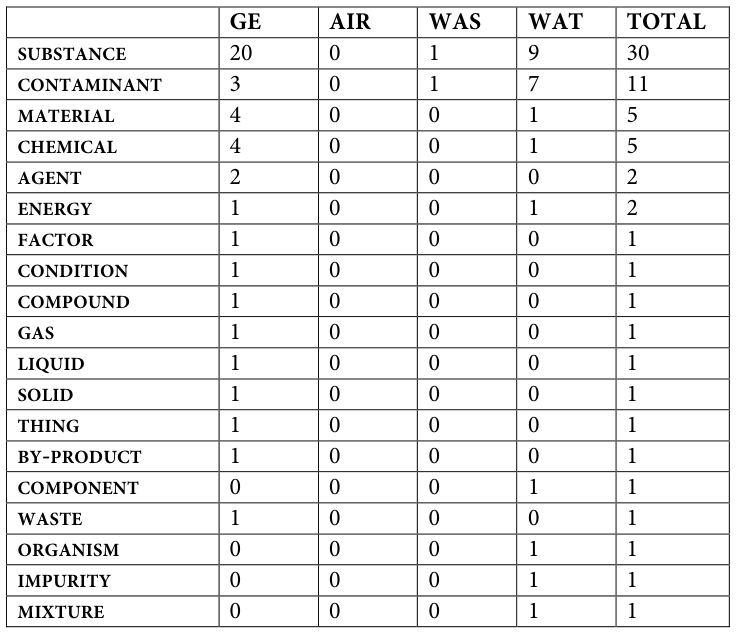
Table 60. Superordinate concept candidates of POLLUTANT extracted from the definitions of other resources and from corpora
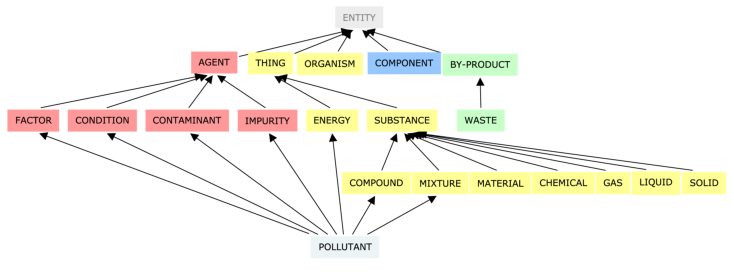
Based on these results, SUBSTANCE is the most frequent superordinate concept of POLLUTANT, followed by CONTAMINANT, MATERIAL, CHEMICAL, AGENT, and ENERGY. In the hierarchy shown in Figure 32, the telic concepts are in pale red; the constitutive concepts are in blue; the agentive concepts are in green; and the formal concepts are in yellow.
In the process of genus choice, it is important to take into account the role that the concept plays in that domain and choose a type of genus accordingly. Both in the general environmental domain and in the domain of WASTE MANAGEMENT, its main role is having a harmful effect, which is a telic trait. Therefore, a telic genus should be chosen in both cases:
CONTAMINANT, AGENT, FACTOR, CONDITION, or IMPURITY.
FACTOR and CONDITION were discarded because they are goal-derived categories (§2.1.3.3.1). They were both extracted from corpora. In the first case, POLLUTANT was categorized as a FACTOR that affects forest health. In the second case, POLLUTANT was conceptualized as a CONDITION that may be responsible for the decline of fish population in the Sacramento-San Joaquin River Delta (California). As for IMPURITY, it is not suitable either because it excludes POLLUTANTS that are not SUBSTANCES such as HEAT, LIGHT, SOUND or MICROORGANISMS.
CONTAMINANT also poses the problem that its extension does not encompass the whole extension of POLLUTANT. CONTAMINANT includes SUBSTANCES and MICROORGANISMS that are in an environment in places where they are not found naturally or in a concentration higher than usual for that environment. In most cases, CONTAMINANT comprises the extension of POLLUTANT (POLLUTANT can be defined as a harmful CONTAMINANT in those casesSometimes, the term contaminant is also used erroneously as a synonym of pollutant.). However, LIGHT, SOUND, and HEAT are not part of the extension of CONTAMINANT, but are considered POLLUTANTS (although they are not prototypical members of the category). In other words, whereas most POLLUTANTS are types of CONTAMINANT, not all POLLUTANTS are CONTAMINANTS. Therefore, CONTAMINANT cannot be used as the genus of POLLUTANT.
AGENT is a generic concept that includes any kind of ENTITY that produces a result or is used to produce a result. Since it does encompass the whole extension of POLLUTANT, we designated AGENT as the general environmental superordinate concept and as the WASTE MANAGEMENT preferential superordinate concept for POLLUTANT.
5.4.1.4. Definition of POLLUTANT
This section presents the flexible definition for POLLUTANT and discusses it. However, it is first necessary to explain certain modifications that we made to the definitional templates used in EcoLexicon (§3.4.2).
The first two rows contain the concept being defined (with an indication of its contextual domain), and the definition. The remaining rows are reserved for the definitional conceptual propositions. A proposition row has six columns:
1. Identification number: All propositions are identified by the letter P followed by a number: P1, P2, P3, and so on.
2. Type: The following abbreviations are used to indicate the type of proposition (§3.6.3):
- Direct proposition (DI)
- Indirect specified proposition (SP)
- Indirect explicit proposition (EX)
- Framing proposition (FR) (they are always placed at the end of the template)
3. Status: In the third column, we distinguish whether the proposition is absolute, prototypical, absolute negative, or prototypical negative. Moreover, although relations have their inverse in EcoLexicon, it is important to note that the inverse relation does not necessarily have the same status. The following symbols are used:
- Absolute (@) A proposition is absolute when all the members of the conceptual category being defined meet that condition. For instance, the proposition “METHANE made-of HYDROGEN” is absolute for METHANE because all the members of the category METHANE are made of HYDROGEN. However, as stated above, it does not follow that the inverse “HYDROGEN component-of METHANE” is absolute as well because not all the members of the category HYDROGEN are components of METHANE. The absolute symbol can be combined with the negative symbol.
- Prototypical (π) A proposition is prototypical when the members of the conceptual category being defined prototypically meet that condition. For instance, if the proposition “POLLUTANT result-of ARTIFICIAL PROCESS” is marked as prototypical, it means that a POLLUTANT is prototypically the result of an ARTIFICIAL PROCESS, although not all members of the category POLLUTANT meet that condition. This sort of prototypical proposition is represented on the definitional template but not codified in EcoLexicon (because it would give rise to false inheritance). In definitions, prototypical propositions are inherited, and they maintain the prototypical status in the subordinates concepts (unless overriden in the corresponding template). For instance, “POLLUTANT result-of ARTIFICIAL PROCESS has prototypical status, and it is inherited by AIR POLLUTANT as “AIR POLLUTANT result-of ARTIFICIAL PROCESS” also with prototypical status. It can be combined with the negative symbol.
- Negative (!): This symbol is used to make the linking relation negative. For example, if a proposition containing the relation “affects” is marked with the symbol!, the relation is to be interpreted as “does not affect”. The negative symbol is always used in combination with either the absolute symbol or the prototypical symbol. For instance, on the one hand, if the proposition “CHEMICAL DECOMPOSITION affects CHEMICAL ELEMENT” is marked with “@!” (absolute negative), this would mean that CHEMICAL COMPOSITION never affects CHEMICAL ELEMENTS. On the other hand, if the proposition “CHEMICAL DECOMPOSITION affects CHEMICAL ELEMENT” is marked with “π!” (prototypical negative), this would mean that CHEMICAL COMPOSITION normally does not affect CHEMICAL ELEMENTS. Negative propositions are represented in the definitional template but are not codified in EcoLexicon because the knowledge base currently does not allow it.
4. First concept(s): This column is used for the first concept or concepts of the proposition. If more than one concept is included in the cell, they are linked by any of these operatorsThe order of precedence is: x, & and |. When there are several operators of the same type, they operate from left to right. If the order of precedence needs to be changed, parentheses are used.:
- & (conjunction): This operator links concepts in a proposition when both of them apply. It corresponds to what in natural language is expressed as “and”. For instance: “METHANE made-of CARBON & HYDROGEN” means that METHANE contains both CARBON and HYDROGEN at the same time.
- | (inclusive disjunction): This operator corresponds to what in natural language is expressed as “and/or”. For instance, “OZONE-DEPLETING SUBSTANCE made-of CHLORINE | BROMINE”, means that an OZONE-DEPLETING SUBSTANCE contains CHLORINE, BROMINE, or both.
- x (exclusive disjunction): This operator expresses that only one of concepts is applicable separately but never at the same time. For instance, the prototypical proposition “POLLUTANT result-of INCINERATION x LANDFILL USE” means that a pollutant is usually the result of either incineration or landfill use. The same member of the category POLLUTANT cannot result from both processes simultaneously.
5. Relation: Only the relations in EcoLexicon were used. However, in the case of the affects relation, a specification in brackets was added when deemed necessary.
6. Second concept(s). This column is used for the second concept or concepts of the proposition. The may also make use of the operators presented above.
Finally, it is important to note that inferred propositions are included in the templates if they are represented in the definition. For the reasons explained on §3.6.5, they are not codified in EcoLexicon propositions.
5.4.1.4.1. AIR QUALITY MANAGEMENT contextualized definition of POLLUTANT
Given that POLLUTANT in AIR QUALITY MANAGEMENT is subconceptualized as AIR POLLUTANT, the contextualized definition of POLLUTANT in this contextual domain consists of a hyperlink to the AIR QUALITY MANAGEMENT contextualized definition of that concept:

Table 61. Filled-out definitional template of POLLUTANT (AIR QUALITY MANAGEMENT contextual domain)
5.4.1.4.2. WASTE MANAGEMENT contextualized definition of POLLUTANT
POLLUTANT in WASTE MANAGEMENT only has one contextual preferential superordinate concept (AGENT), which coincides with the general environmental one. Its hierarchical path is POLLUTANT>AGENT>ENTITY. ENTITY is considered a semantic primitive and it has no propositions associated with it. Therefore, POLLUTANT only inherits propositions from AGENT. Since AGENT does not show significant contextual variation, it only has one definition and its propositions are not contextualized:
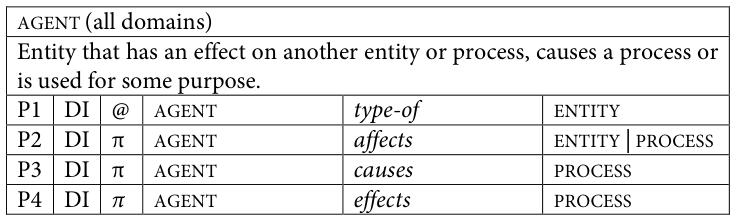
Table 62. Filled-out definitional template of AGENT (all domains)
Table 63 shows the contextualized definition of POLLUTANT in WASTE
MANAGEMENT.
POLLUTANT (WASTE MANAGEMENT) Agent that adversely affects the environment (e.g., air, water, and soil) or human health. Types of pollutant include substances (e.g., carbon dioxide, sulfur dioxide, or dioxins), pathogens, and certain forms of
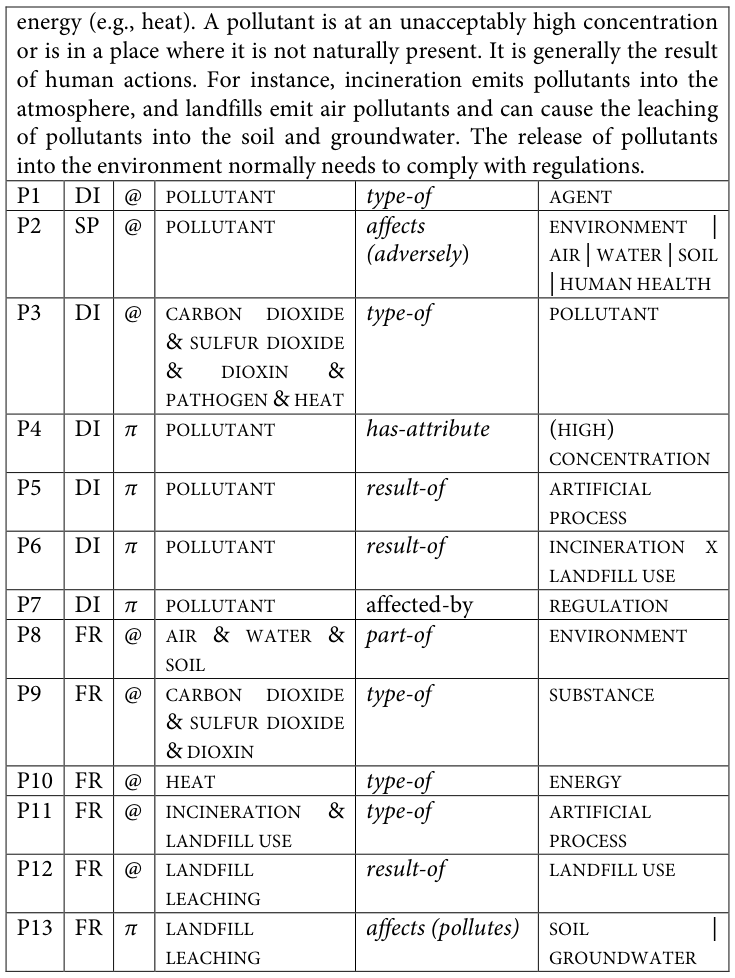
Table 63. Filled-out definitional template of POLLUTANT (WASTE MANAGEMENT contextual domain)
P1 is the proposition that establishes the genus in all definitional templates. Other propositions might be inherited from it, like P2 in this case, which is inherited from “AGENT affects ENTITY | PROCESS”. Since POLLUTANT in WASTE MANAGEMENT has no non-preferential superordinate concepts, it only inherits propositions from its preferential genus.
Moreover, in P8, a framing proposition, it is specified that AIR, WATER and SOIL are part of the ENVIRONMENT because they are the most prototypical patients of the process of POLLUTION.
Many of the analyzed definitions of POLLUTANT used SUBSTANCE as a genus. However, since not all POLLUTANTS are SUBSTANCES, it cannot be the genus of the definition. Neither can it be said that SUBSTANCES are kinds of POLLUTANT. Instead, by means of P3, we provided the most prototypical examples of POLLUTANTS, according to the contextonyms of POLLUTANT in WASTE MANAGEMENT. Furthermore, in P9, we specified that some of those kinds of POLLUTANT are, at the same time, SUBSTANCES. P10 was also added for the same reason but in relation to HEAT and ENERGY. Both P9 and P10 were included in order to convey the type of entities that can be considered POLLUTANTS, since such specification is not inherited from the genus AGENT. Moreover, it is important to note that CARBON DIOXIDE and SULFUR DIOXIDE are specifically AIR POLLUTANTS, therefore, the proposition “CARBON DIOXIDE & SULFUR DIOXIDE type-of POLLUTANT” was inferred from “CARBON DIOXIDE & SULFUR DIOXIDE type-of AIR POLLUTANT” and “AIR POLLUTANT type-of POLLUTANT”.
In P4, due to the lack of expressiveness of the has-attribute propositions in EcoLexicon, we further specified it in brackets. Furthermore, it is not possible to encode that POLLUTANTS may be in a place where they are not naturally present by employing EcoLexicon propositions.
P5 is marked as prototypical (π) because not all POLLUTANTS are the result of ARTIFICIAL PROCESSES, although most are. The same is true for P7 since not all POLLUTANTS are regulated by standards, and regulations are more or less strict depending on the country. As can be seen, if a proposition has prototypical status instead of absolute status, it is reflected in the wording of the definition by the addition of an adverb (normally, generally, usually, etc.) or the use of modal verbs (can, could, may, etc.).
In P6, INCINERATION and LANDFILL USE are the most relevant subordinates of ARTIFICIAL PROCESS that cause POLLUTION in WASTE MANAGEMENT. That relation is represented with P11. An exclusive disjunction was used to link INCINERATION and LANDFILL USE IN P6 because the same instance of POLLUTANT cannot be simultaneously the result of both INCINERATION and LANDFILL USE.
For their part, P12 is a framing proposition needed to specify the way LANDFILL USE can lead to POLLUTION (by LANDIFLL LEACHING), and P13 specifies that LANDFILL LEACHING typically pollutes SOIL and GROUNDWATER.
Some of the above-mentioned propositions are not directly established by POLLUTANT, but are inferred from “POLLUTANT causes POLLUTION”. We did not represent this proposition in the definition to avoid the use of terms morphologically related to the term denominating the definiendum. However, users can see that proposition on the conceptual map in EcoLexicon.
5.4.1.4.3. WATER TREATMENT AND SUPPLY contextualized definition of POLLUTANT
POLLUTANT in WATER TREATMENT AND SUPPLY is subconceptualized as
WATER POLLUTANT. As a consequence, the contextualized definition of POLLUTANT in this contextual domain consists of a hyperlink to the WATER TREATMENT AND SUPPLY contextualized definition of that concept:

Table 64. Filled-out definitional template of POLLUTANT (WATER TREATMENT AND SUPPLY contextual domain)
5.4.1.4.4. General environmental definition of POLLUTANT
The general environmental definition (Table 65) greatly resembles the one in WASTE MANAGEMENT because the WASTE MANAGEMENT premeaning is a perspective of the general environmental premeaning, and they both share the same genus (AGENT) (Table 62).
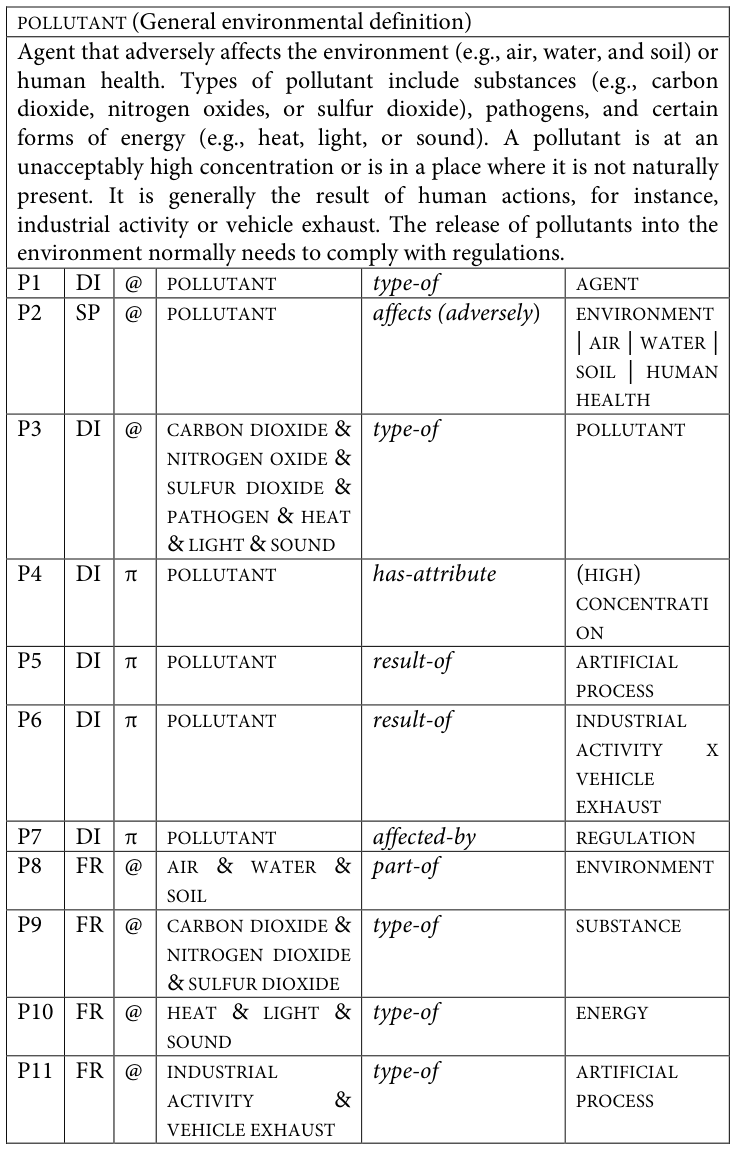
Table 65. Filled-out definitional template of POLLUTANT (general environmental domain)
Several of the propositions of the general environmental definition are the same as in the WASTE MANAGEMENT definition: P2, P5, P7, and P8.
In P3, the most prototypical examples of POLLUTANTS, based on the general environmental contextonyms of POLLUTANT, are represented. LIGHT and SOUND were also added because they were important to show the extension of the concept. As with the WASTE MANAGEMENT definition of POLLUTANT, in P9 and P10, we added that those prototypical POLLUTANTS are, at the same time, SUBSTANCES or ENERGY. The propositions “CARBON DIOXIDE & NITROGEN OXIDE & SULFUR DIOXIDE type-of POLLUTANT” were inferred from “CARBON DIOXIDE & NITROGEN OXIDE & SULFUR DIOXIDE type-of AIR POLLUTANT” and “AIR POLLUTANT type-of POLLUTANT”.
As can be observed, the examples of source of POLLUTANTS in P6 are not INCINERATION and LANDFILL USE, but rather INDUSTRIAL ACTIVITY and VEHICLE EXHAUST, following the analysis of the general environmental contextonyms. Finally, P11 specifies that INDUSTRIAL ACTIVITY and VEHICLE EXHAUST are types of ARTIFICIAL PROCESS.
5.4.1.4.5. Flexible definition of POLLUTANT
Table 66 shows the flexible definition of POLLUTANT. Users would access the definitions separately, depending on the contextual domain chosen in EcoLexicon.
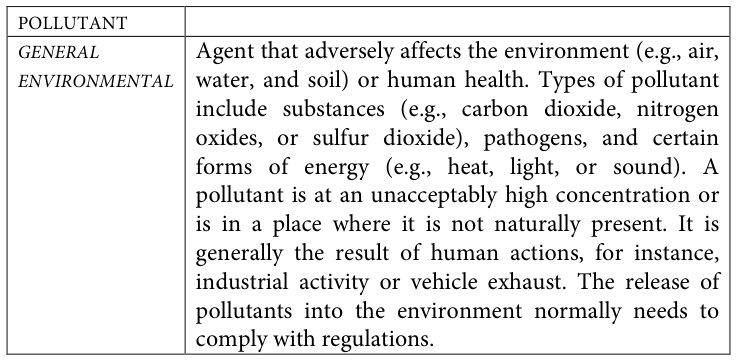
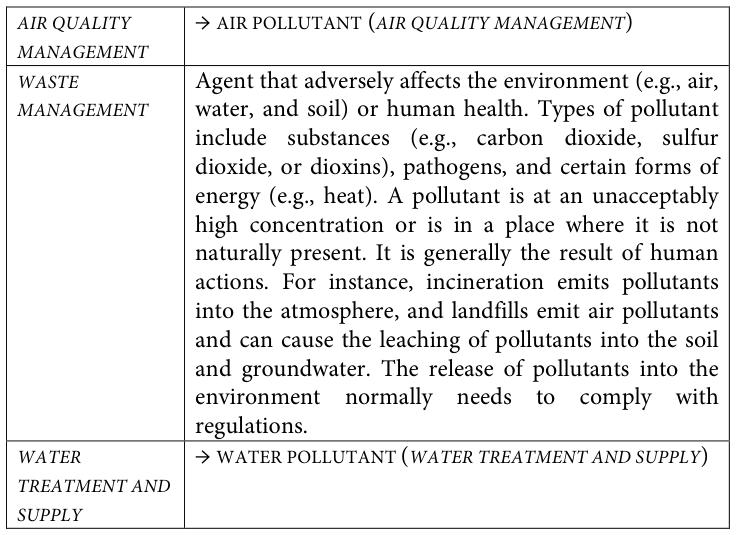
Table 66. Flexible definition of POLLUTANT
5.4.2. A concept with perspectives: CHLORINE
As shown in Table 67, CHLORINE appears with a frequency of over 64 occurrences in the domains of AIR QUALITY MANAGEMENT, CHEMISTRY, and WATER TREATMENT AND SUPPLY.

Table 67. Frequency of the term chlorine (noun) in the corresponding contextual domains according to TermoStat
For the creation of the flexible definition of CHLORINE, we followed the same steps as for POLLUTANT.
5.4.2.1. Definitions of CHLORINE from other resources
A total of 29 definitions of CHLORINE were extracted from different terminological resources. The complete list of definitions can be found in Annex 5. Two of those definitions belonged to the domain of AIR QUALITY MANAGEMENT, two to CHEMISTRY, 12 to WATER TREATMENT AND SUPPLY, and 13 were environmental definitions (i.e., belonging to other environmental domains or encompassing the whole environmental domain).
The following tables summarize the characteristics represented in the environmental definitions (Table 68), AIR QUALITY MANAGEMENT definitions (Table 69), CHEMISTRY definitions (Table 70) and WATER TREATMENT AND SUPPLY definitions (Table 71).
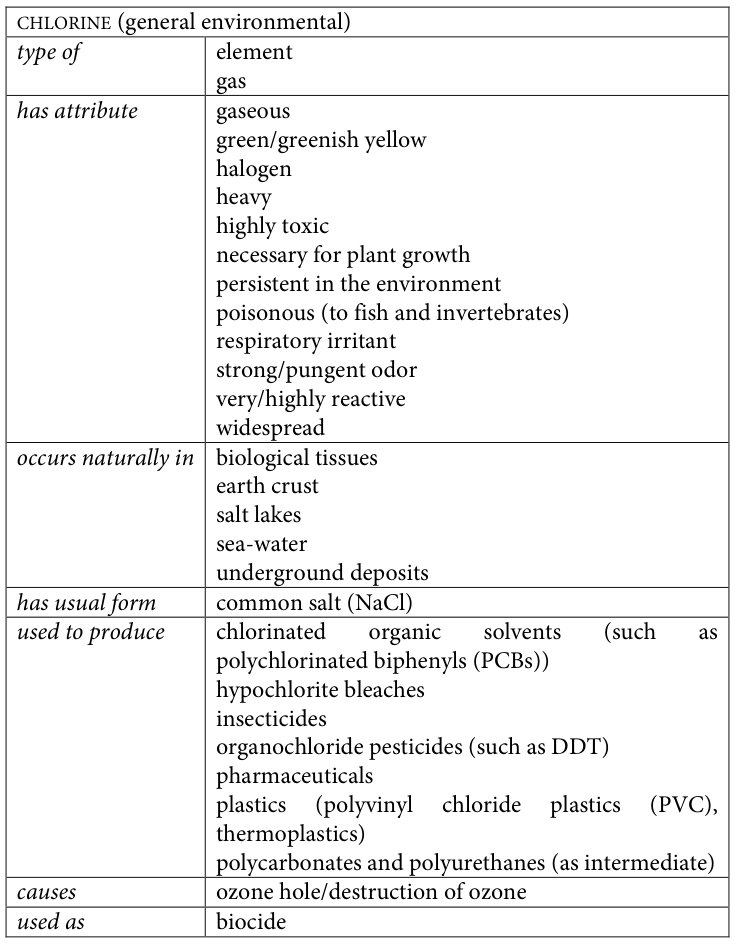
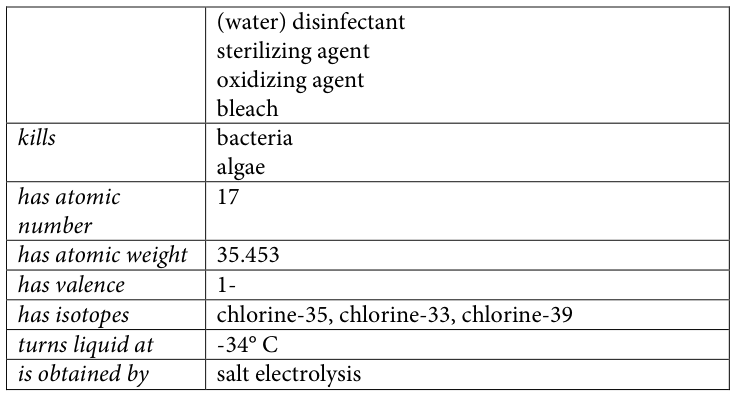
Table 68. Characteristics of CHLORINE represented in the definitions from other resources that belong to other environmental domains or the whole environmental domain
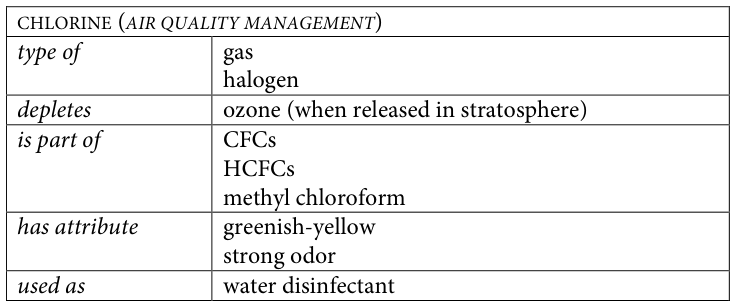
Table 69. Characteristics of CHLORINE represented in the definitions from other resources that belong to the domain of AIR QUALITY MANAGEMENT
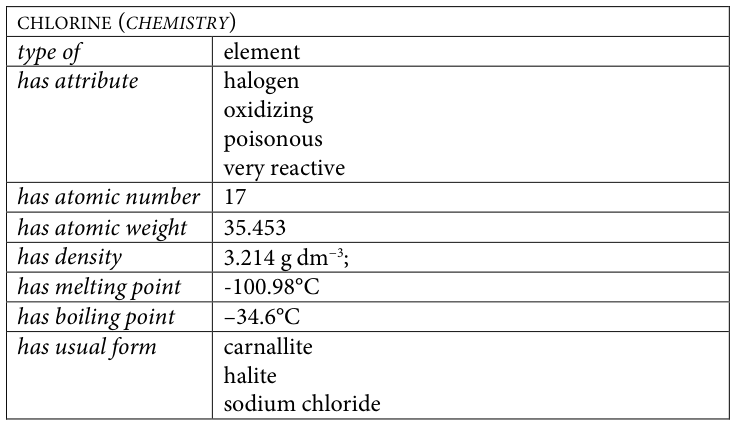
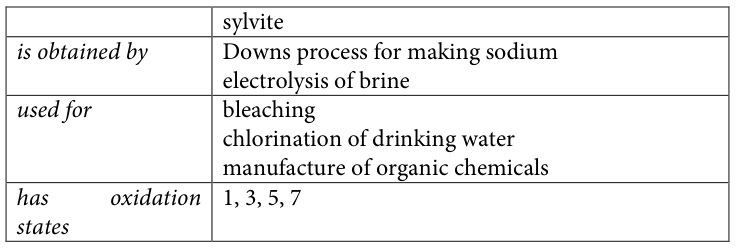
Table 70. Characteristics of CHLORINE represented in the definitions from other resources that belong to the domain of CHEMISTRY
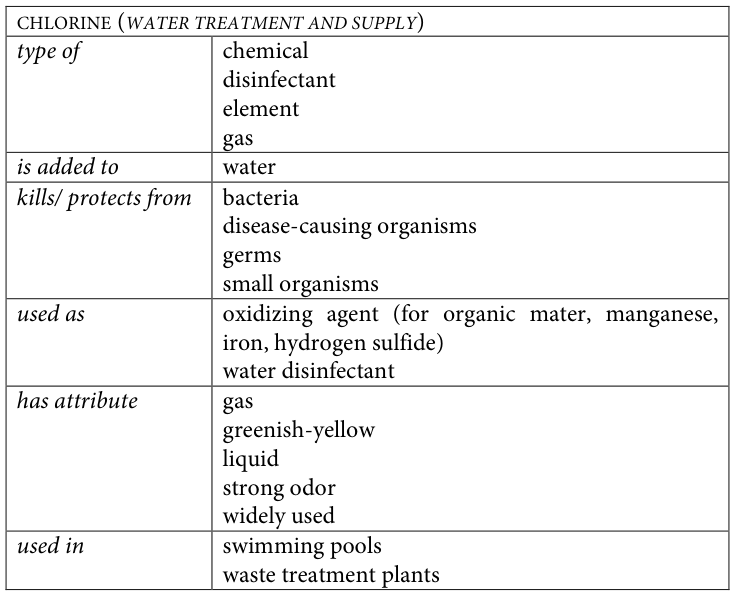
Table 71. Characteristics of CHLORINE represented in the definitions from other resources that belong to the domain of WATER TREATMENT AND SUPPLY
The environmental definitions represent a variety of characteristics: color, standard state, toxicity, odor, reactivity, atomic number, atomic weight, usual location, natural form, how humans use it, the consequences of its use, etc. Each definition focuses on certain of those characteristics.
As for the two definitions belonging to the domain of AIR QUALITY
MANAGEMENT, one of them focuses on its role in ozone depletion, whereas the other one gives a general description of the concept, without reference to it role in the domain. This is the reason why in Table 69, the attribute of strong odor or its function as water disinfectant are listed, although they are not relevant in the domain.
The chemical definitions offer some characteristics that did not appear in other definitions such as density, boiling point, mode of production and oxidation states.
Finally, the WATER TREATMENT AND SUPPLY definitions for CHLORINE focus on its use in water treatment, such as what type of undesirable elements in water are affected by chlorine and in which kind of facilities chlorine is employed.
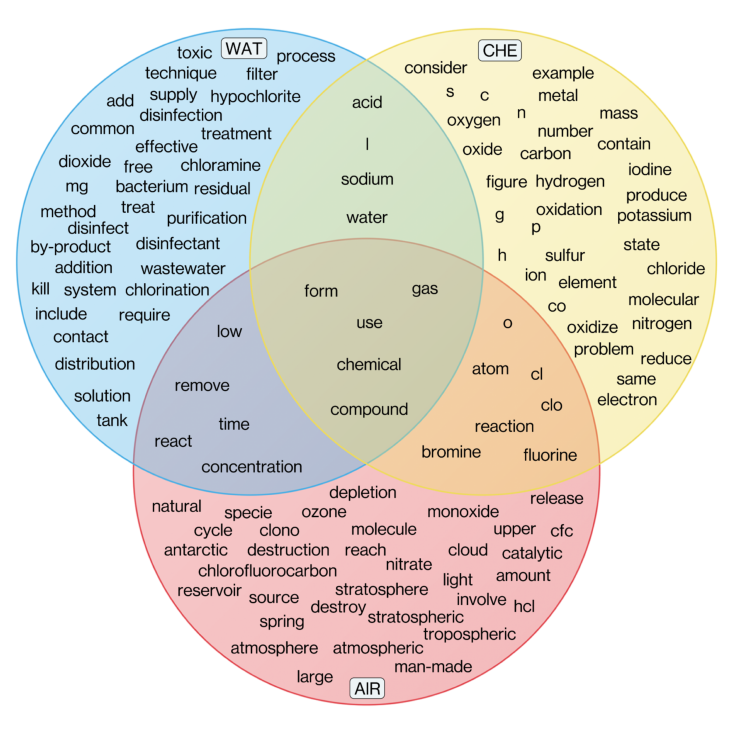
5.4.2.2. Contextonyms of chlorine
In order to obtain a clear image of the contextual variation that the concept chlorine experiences in its contextual domains, we analyzed the first 100 contextonyms for the MULTI corpus and the corresponding subcorpora (AIR QUALITY MANAGEMENT, CHEMISTRY, and WASTE MANAGEMENT). The complete lists are in Annex 6.
Figure 33 is a visual representation in a Venn diagram of the first 50 contextonyms for the contextual domains of AIR QUALITY MANAGEMENT, CHEMISTRY and WASTE MANAGEMENT.
The following subsections outline the results of the analysis of the contextonyms (with the help of their corresponding concordances) in each contextual domain and of the general environmental contextonyms (extracted from the whole MULTI corpus).
5.4.2.2.1. AIR QUALITY MANAGEMENT contextonyms of chlorine
The most important contextonyms of chlorine in AIR QUALITY
MANAGEMENT show how CHLORINE is conceptualized as contributing to the depletion of stratospheric ozone. The process of ozone depletion is a series of subprocesses that start with the emission of ozone-depleting substances, which are man-made compounds containing chlorine or bromine, such as chlorofluorocarbons (CFCs), hydrochlorofluorocarbons (HCFCs). Some ozone-depleting substances contain fluorine as well, but this chemical element does not contribute significantly to ozone depletion. Although some natural processes release chlorine to the atmosphere, man-made substances are the main source of stratospheric chlorine, which has experienced an increase in concentration since the 1960s.
Ozone-depleting substances do not destroy ozone (O3) directly. Firstly, they reach the stratosphere transported by air motions. Then, they are converted by ultraviolet light and chemical reactions into hydrochloric acid (HCl), and chlorine nitrate (ClONO2), which are gasses that act as chlorine reservoirs species. Those two compounds are finally converted into chlorine monoxide (ClO) (especially in Antarctic polar stratospheric clouds) or free chlorine atoms, which react with ozone molecules in a catalytic cycle destroying large amounts of ozone before being removed from the stratosphere.
5.4.2.2.2. WATER TREATMENT AND SUPPLY contextonyms of chlorine
The first 50 contextonyms for chlorine in WATER TREATMENT AND SUPPLY clearly show that CHLORINE is part of a frame that could be called WATER DISINFECTION. Disinfection with chlorine is called chlorination, and it is a treatment that consists of the addition of chlorine to water in order to deactivate or kill pathogens, such as bacteria or viruses. It is usually carried out in a chlorine-contact tank. The main forms in which it is used are chlorine gas (Cl2) sodium hypochlorite, calcium hypochlorite, chlorine dioxide or chloramine.
Chlorination is considered to be part of the tertiary treatment of water. The primary includes mechanical methods (e.g., sedimentation), and the secondary treatment includes biological methods (e.g., the activated sludge process). Filtration is included in many different forms during primary and secondary treatment.
While chlorination is an effective method of disinfection, it has two main drawbacks. Chlorine reacts with organic compounds that may be present in the water to form harmful by-products: trihalomethanes and haloacetic acids. Moreover, since residual chlorine in treated water is toxic to aquatic life, it needs to be removed before discharging in aquatic ecosystems through a process called dechlorination. The presence of high levels of chlorine in water is always the result of chlorination. Therefore, the process of DECHLORINATION could be regarded as an optional phase in the CHLORINATION frame, in which CHLORINE is a participant.
5.4.2.2.3. CHEMISTRY contextonyms of chlorine
CHEMICAL ELEMENTS tend to be hyperversatile in the domain of CHEMISTRY because they can participate in many different types of process. CHLORINE is not an exception and the fact that its contextonyms in CHEMISTRY are very varied, and point to many different processes indicates its hyperversatility in this domain.
The first three contextonyms correspond to its symbol (Cl), a hyperonym (element) and its standard state and hyperonym (gas). The analysis also shows that chlorine possesses a strong oxidizing power, which means that it has the tendency to react and cause oxidation (loss of electrons) on other elements and simultaneously undergo reduction. As well as the other halogen elements (i.e., fluorine, bromine, iodine, and astatine), it is diatomic in its elemental state, and when it reacts with a metal (e.g., sodium or potassium) it results in salts (such as sodium chloride), which are ionic compounds.
Some of its most important contextonyms are other chemical elements with which it tends to form compounds: oxygen (e.g., chlorine monoxide), hydrogen (e.g., hydrogen chloride (or hydrochloric acid in water)), sulfur (e.g., sulfur dichloride), nitrogen (e.g., chlorine nitrate), and carbon (e.g., carbon tetrachloride).
5.4.2.2.4. General environmental contextonyms of chlorine
As can be seen in Figure 34, the first 50 contextonyms in the general environmental domain coincide almost entirely with one of the three relevant contextual domains. The exceptions are the terms product and PCB. In the concordances, product mainly refers to commodities manufactured using chlorine. As for PCB, it is, in fact, a chlorine- containing product that, before being banned for its high toxicity, was widely employed in many different industries. In view of these two contextonyms, an example of some of the most common products made with chlorine was included in our general environmental definition of CHLORINE.
We also contrasted the first 100 general environmental contextonyms with those of the contextual domains. The general environmental list had the following exclusive contextonyms (including PCB and product): ammonia, chlorinate, cost, high, material, ppm, and waste.
High and material were too versatile to be able to determine a clear relation with CHLORINE. As for the remaining ones, they are all related to the contextual domain of WATER TREATMENT AND SUPPLY. According to the concordances, ammonia and chlorine are related because they form chloramine together (employed in chlorination). Chlorinate is the verb for chlorination. Cost is mostly used to make reference to the cost of the different chlorine-derived disinfectants. Waste appears on the list due to the alternative spelling of wastewater as two separate words. Finally, ppm stands for parts per million, which is a usual unit of measurement to
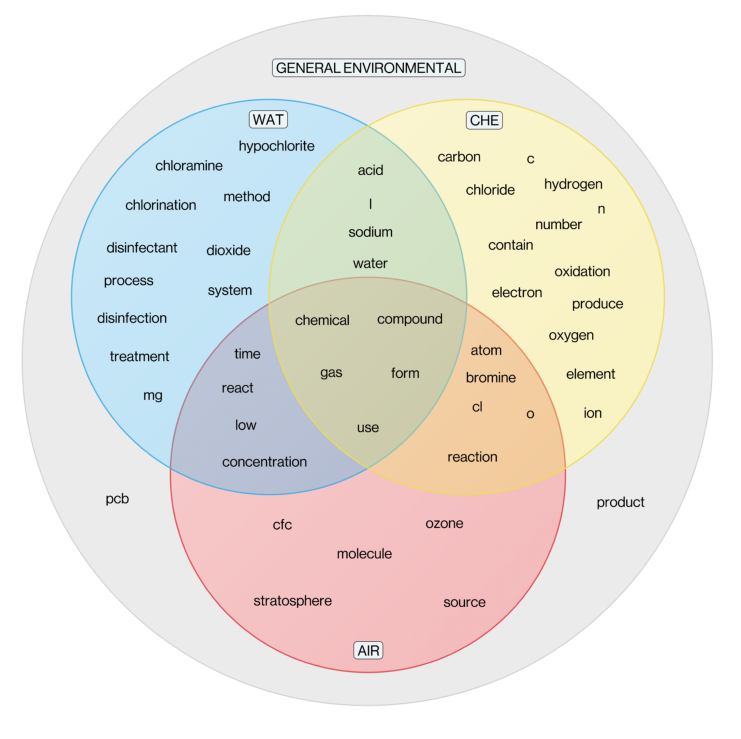
quantify the concentration of chlorine in water.
5.4.2.3. Extraction of superordinate concepts and choice of genera for CHLORINE
As with POLLUTANT, superordinate concept candidates were extracted from the definitions of other resources that we had already analyzed and from corpora. Table 72 shows the result of the extraction of genera from the definitions.
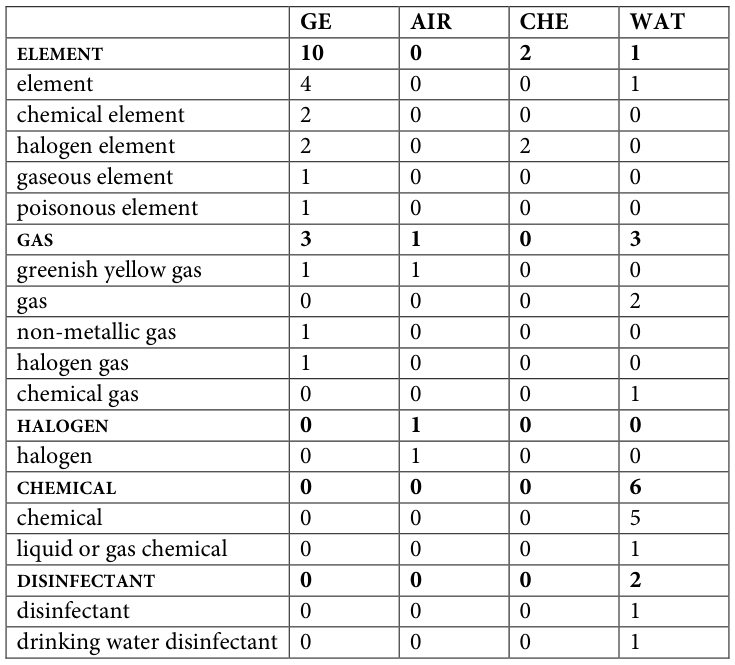
Table 72. Superordinate concept candidates of CHLORINE extracted from the definitions of other resources
The general environmental definitions have a preference for the genus
ELEMENT, followed by GAS. In AIR QUALITY MANAGEMENT only two genera were extracted: GAS and HALOGEN. In CHEMISTRY, both analyzed definitions had ELEMENT as superordinate concept. Finally, WATER TREATMENT AND SUPPLY favored CHEMICAL, followed by GAS and DISINFECTANT.
These results were complemented with superordinate concepts extracted from corpora. Six were obtained from the MULTI corpus: one from the AIR QUALITY MANAGEMENT subcorpus, one from the CHEMISTRY subcorpus, and three from the general environmental subcorpus:

Table 73. Hypernymic knowledge-rich contexts for the lemma chlorine (noun) in the MULTI corpus
We also obtained 17 superordinate concept candidates from the PANACEA corpus:
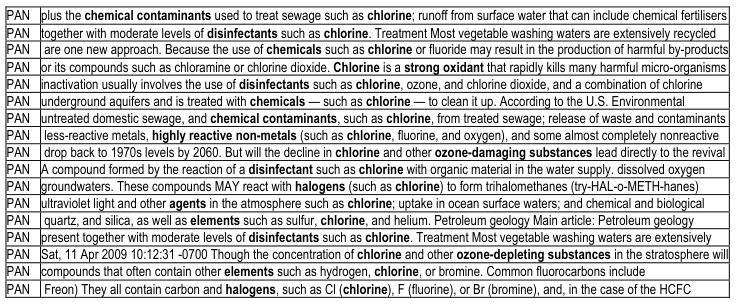
Table 74. Hypernymic knowledge-rich contexts for the lemma chlorine (noun) in the PANACEA corpus
Table 75 summarizes the results of the extraction of superordinate concepts candidates from corpora:
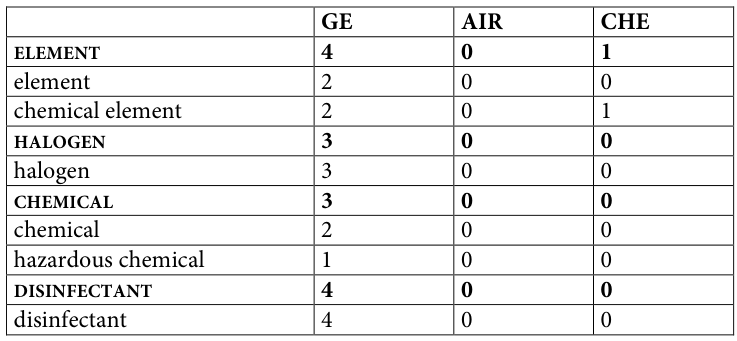
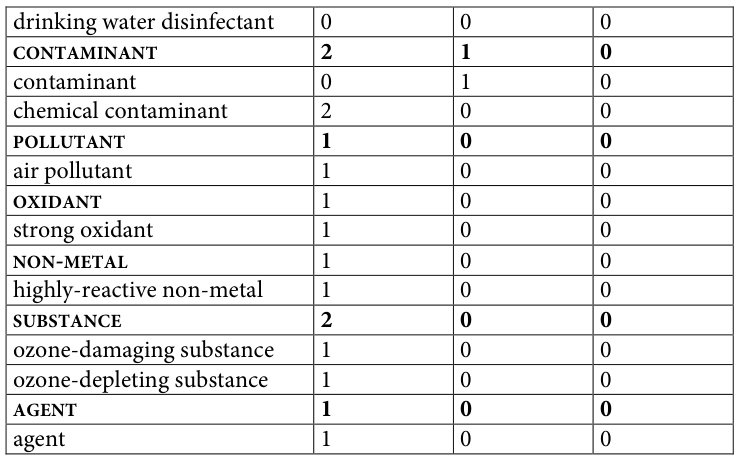
Table 75. Superordinate concept candidates of CHLORINE extracted from corpora
Among the general environmental contexts (the ENV subcorpus and PANACEA), the most common superordinate concepts were ELEMENT and DISINFECTANT, followed by HALOGEN, CHEMICAL, CONTAMINANT, and SUBSTANCE. The only superordinate extracted for AIR QUALITY MANAGEMENT was CONTAMINANT, and the only one for CHEMISTRY was ELEMENT.
Some of the candidates were a combination of simpler candidates, such as chemical element, halogen gas, gaseous element, halogen element, etc. However, for the sake of clarity, Table 76 shows the results merged from the definitions of other resources and from hypernymic knowledge-rich contexts from corpora and limited only to the head in case the of nominal phrases:
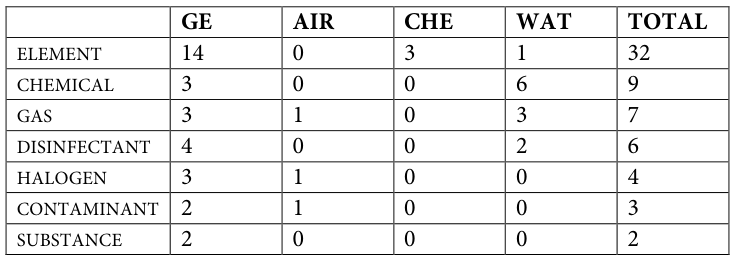
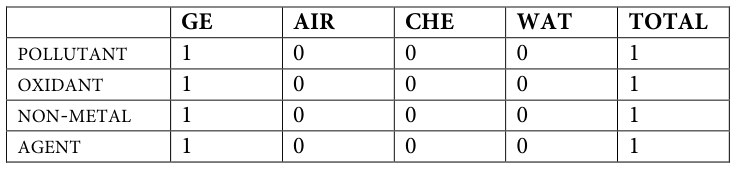
Table 76. Superordinate concept candidates of CHLORINE extracted from the definitions of other resources and from corpora
For the whole environmental domain, the most frequent superordinate concepts were in this order: ELEMENT, CHEMICAL, GAS, DISINFECTANT, and HALOGEN. For the contextual domains, the results are inconclusive because of the small sample. In AIR QUALITY MANAGEMENT, GAS, HALOGEN and CONTAMINANT appear with one occurrence each. In CHEMISTRY, ELEMENT has three occurrences. In WATER TREATMENT AND SUPPLY, the most frequent superordinate concept is CHEMICAL, followed by GAS and DISINFECTANT.
All the extracted superordinate concepts were structured in a hierarchy (Figure 35). Functional concepts appear in green, and formal concepts appear in orange.
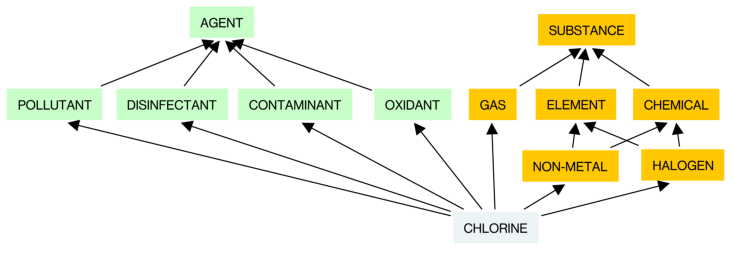
In AIR QUALITY MANAGEMENT and WATER TREATMENT AND SUPPLY, a telic genus is needed since in both domains the concept CHLORINE is profiled in a frame where they serve a function. In CHEMISTRY and the general environmental domain, a formal genus is needed.
The general environmental domain takes a superordinate concept that is applicable to all other domains. In this case, CHEMICAL ELEMENT was the most suitable since in all contextual domains CHLORINE is also regarded as a CHEMICAL ELEMENT. The hierarchical path was CHEMICAL ELEMENT>SUBSTANCE>ENTITY. As explained in §3.6.3, the general environmental superordinate concept is at the same time a non- preferential genus for all other contextual domains. Furthermore, the general environmental domain takes as non-preferential all the other preferential and non-preferential genera in contextual domains.
In the case of AIR QUALITY MANAGEMENT, we used AIR POLLUTANT as genus because, although the polluting nature of CHLORINE stems mainly from the fact that it depletes the stratospheric ozone, the category of OZONE- DEPLETING SUBSTANCE is limited to substances containing chlorine or bromine as per the Montreal Protocol on Substances that Deplete the Ozone Layer (United Nations Environment Programme 2000) that was approved 1989 but is still in force. CONTAMINANT was discarded because it is less specific than POLLUTANT. Thus, the preferential hierarchical path for CHLORINE in this contextual domain is AIR POLLUTANT>POLLUTANT>AGENT>ENTITY. HALOGEN ELEMENT and GAS are also included as non-preferential superordinate concepts.
WATER DISINFECTANT was the chosen genus for CHLORINE in WATER
TREATMENT AND SUPPLY. OXIDANT was discarded because it does not reflect as clearly the role of CHLORINE in WATER TREATMENT as WATER DISINFECTANT does. However, the oxidizing nature of CHLORINE, which is what makes it a powerful WATER DISINFECTANT, was included as a characteristic of the concept in our WATER TREATMENT AND SUPPLY definition. The preferential hierarchical path for CHLORINE in this contextual domain was thus WATER DISINFECTANT>DISINFECTANT>AGENT.
Finally, we chose HALOGEN ELEMENT as the preferential superordinate genus of chlorine in CHEMISTRY since CHEMICAL ELEMENT was too generic for the domain. We chose HALOGEN ELEMENT because it ranked higher than NON-METAL ELEMENT in our superordinate concept extraction. Consequently, the preferential hierarchical path for CHLORINE in CHEMISTRY is HALOGEN ELEMENT>CHEMICAL ELEMENT>SUBSTANCE>ENTITY.
NON-METAL ELEMENT and GAS are also included as non-preferential superordinate concepts.
All of the resulting hierarchical paths (general environmental and contextual subdomains) for CHLORINE are represented in Figure 36.
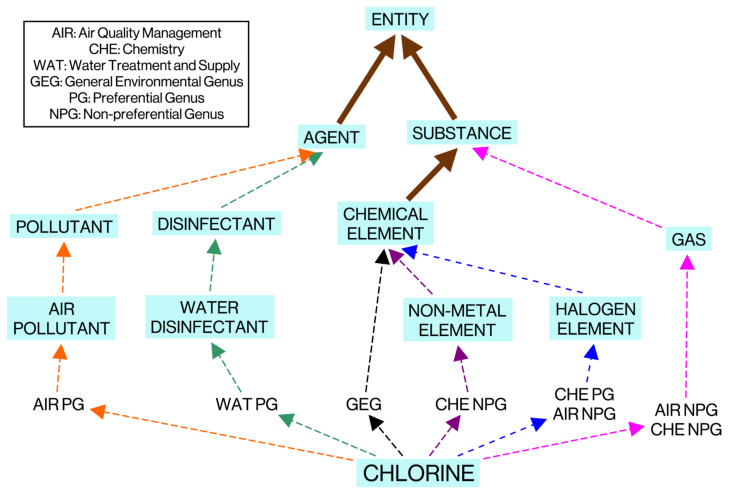
5.4.2.4. Definition of CHLORINE
5.4.2.4.1. AIR QUALITY MANAGEMENT contextualized definition of CHLORINE
CHLORINE in AIR QUALITY MANAGEMENT has AIR POLLUTANT as preferential genus, CHEMICAL ELEMENT as general environmental genus (which thus acts as non-preferential genus), as well as HALOGEN ELEMENT and GAS as non-preferential genera. All the hierarchical paths are represented in Figure 37.
The top superordinate concept for all of the genera of CHLORINE is ENTITY, which, as has already been said it is considered a semantic primitive, and has no propositions attached. The second level is occupied by AGENT (Table 62) and SUBSTANCE (Table 77), all of which are the same for all domains. Thus, they have only one definition each, and their propositions are not contextualized.

Table 77. Filled-out definitional template of SUBSTANCE (all domains)
In the third level of preferential hierarchical path for AIR QUALITY
MANAGEMENT, the subordinate of AGENT is POLLUTANT. As seen in §5.4.1.2.1, POLLUTANT in AIR QUALITY MANAGEMENT is subconceptualized as AIR POLLUTANT. AIR POLLUTANT in AIR QUALITY MANAGEMENT is a subordinate concept of POLLUTANT as conceptualized in the general environmental domain. Therefore, CHLORINE inherits from POLLUTANT as conceptualized in the general environmental domain (Table 65) and, then, as AIR POLLUTANT as conceptualized in AIR QUALITY MANAGEMENT (to which we will come back later).
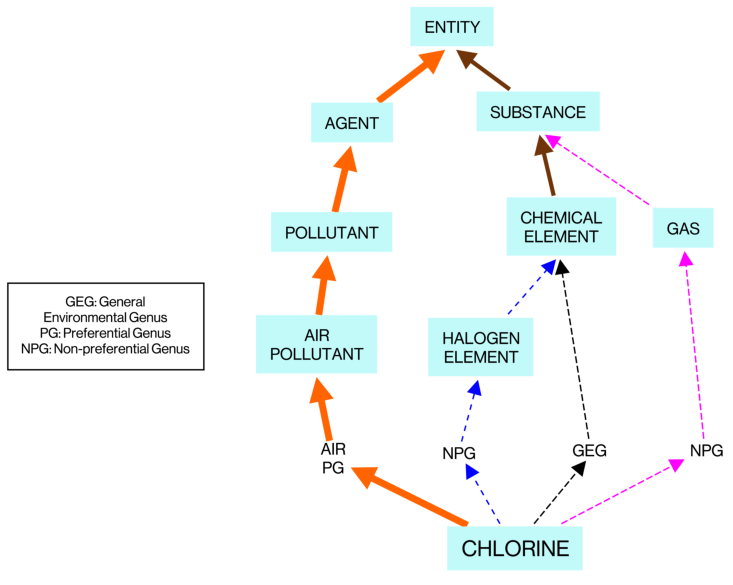
In the third level, there are also CHEMICAL ELEMENT (general environmental path) and GAS (non-preferential path). CHEMICAL ELEMENT (Table 78) is not contextualized in AIR QUALITY MANAGEMENT and, therefore, CHLORINE inherits from its general environmental template. However, GAS is contextualized in this domain and, thus, CHLORINE inherits from a template specific for AIR QUALITY MANAGEMENT (Table 79).
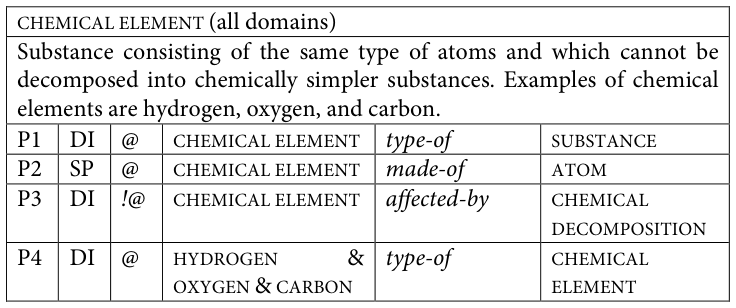
Table 78. Filled-out definitional template of CHEMICAL ELEMENT (all domains)
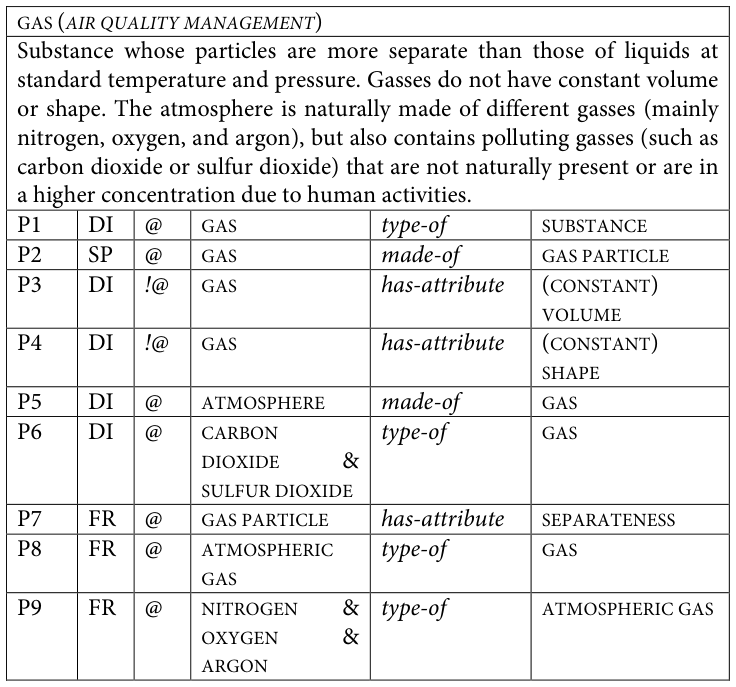
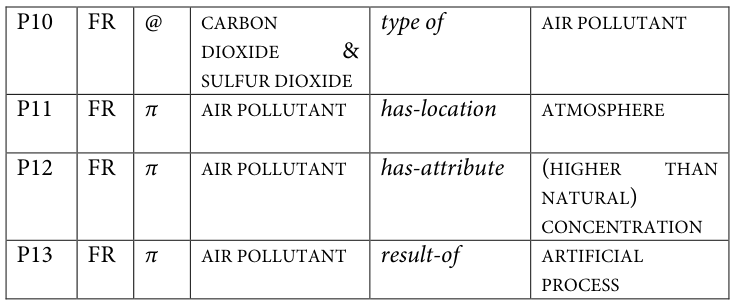
Table 79. Filled-out definitional template of GAS (AIR QUALITY MANAGEMENT domain)
Finally, on the fourth level, there is one non-preferential superordinate (HALOGEN ELEMENT) (Table 80) that is a subordinate of CHEMICAL ELEMENT, and the preferential superordinate AIR POLLUTANT (Table 81). Both of them have contextualized templates in this contextual domain.
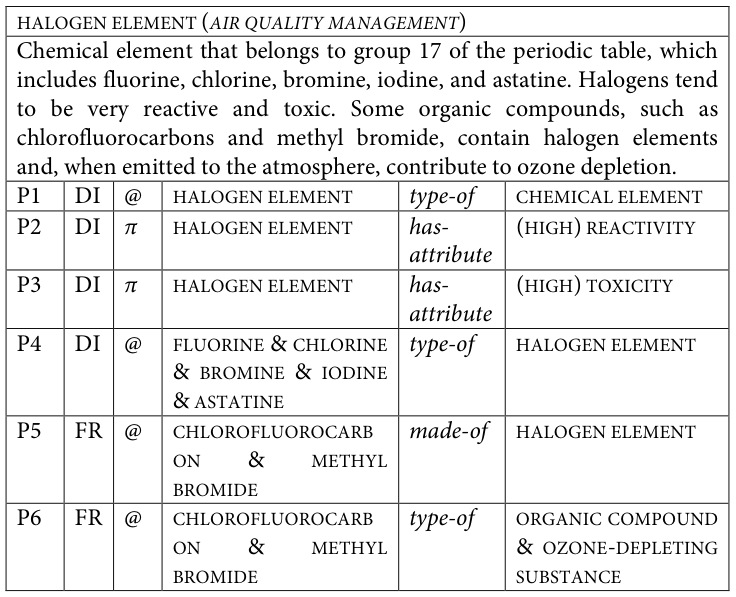
Table 80. Filled-out definitional template of HALOGEN ELEMENT (AIR QUALITY MANAGEMENT domain)
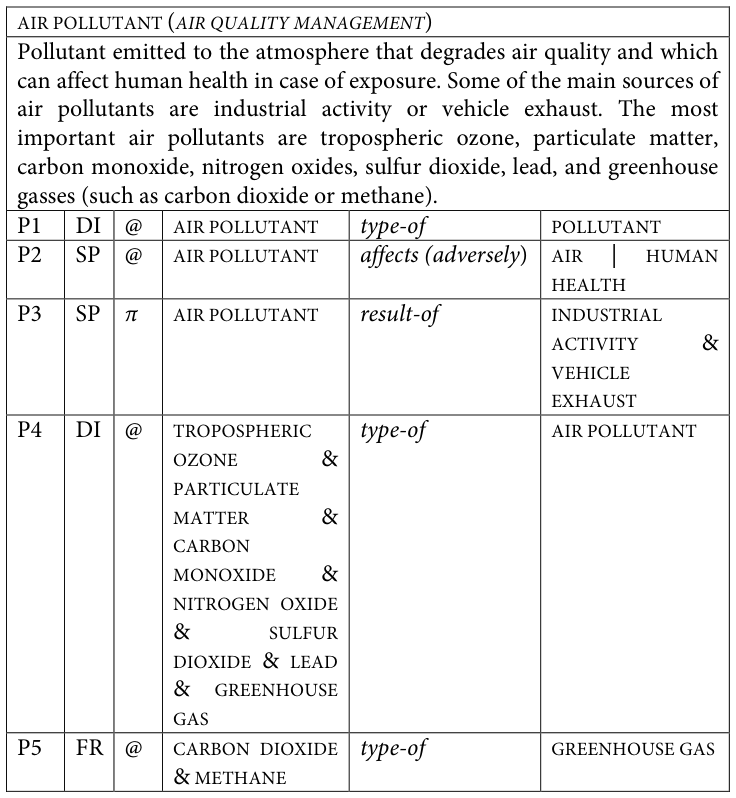
Table 81. Filled-out definitional template of AIR POLLUTANT (AIR QUALITY MANAGEMENT domain)
Finally, we reproduce below the contextualized definition for CHLORINE in AIR QUALITY MANAGEMENT, which, as previously explained, has AIR POLLUTANT as its genus, but also GAS, HALOGEN ELEMENT, and CHEMICAL ELEMENT as its non-preferential superordinate concepts.
CHLORINE (AIR QUALITY MANAGEMENT) Air pollutant emitted mainly as chlorofluorocarbons, hydrochlorofluorocarbons, carbon tetrachloride, and methyl chloroform, which are ozone-depleting substances. When these substances reach the stratosphere, ultraviolet radiation and chemical reactions break them apart, and they are converted into hydrochloric acid and chlorine nitrate. Those two compounds are finally converted into chlorine monoxide or free chlorine atoms, which destroy
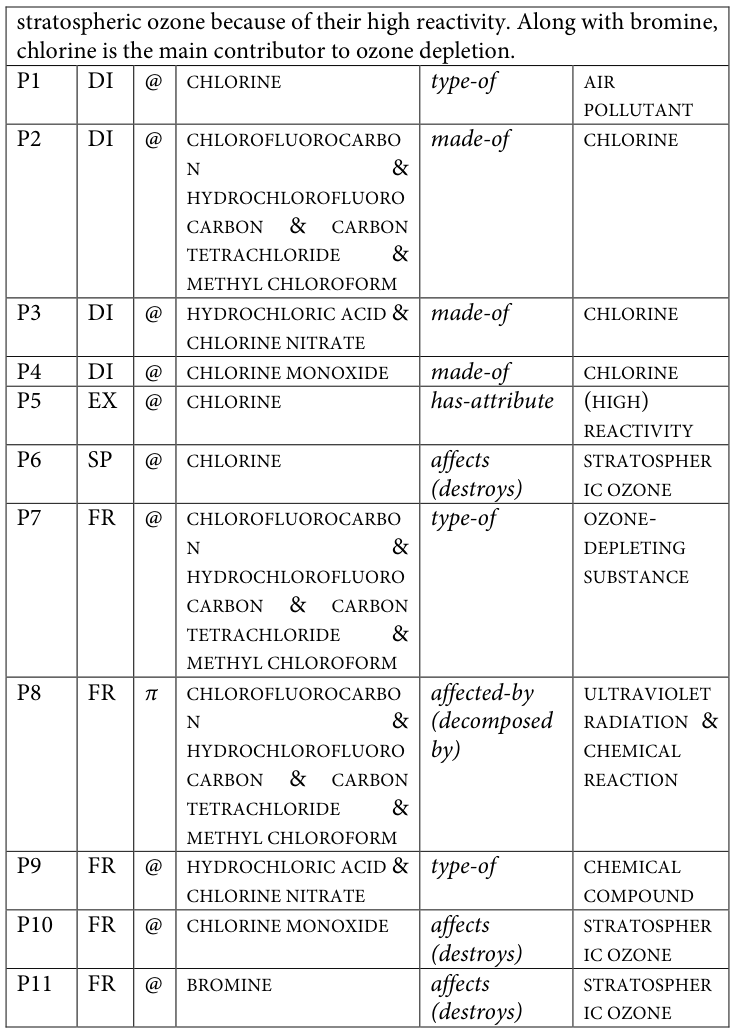
Table 82. Filled-out definitional template of CHLORINE (AIR QUALITY MANAGEMENT domain)
It was not possible to accurately encode various of the definitional characteristics of CHLORINE in the template. The main reason for this is that the underlying frame of this definition (OZONE DEPLETION) comprises several phases in which many participants interact. As a consequence, there were certain relations that could only be expressed in the definition.
For instance, the part of the process consisting of (chlorine-containing)
OZONE-DEPLETING SUBSTANCES reaching the STRATOSPHERE and then being converted into HYDROCHLORIC ACID and CHLORINE NITRATE by ULTRAVIOLET RADIATION and CHEMICAL REACTIONS could not be completely expressed. The only possible proposition related to it is P8, which is marked as prototypical instead of absolute because it does not express a characteristic always associated with those concepts. The decomposition of these substances by ultraviolet radiation and chemical reactions into hydrochloric acid and chlorine nitrate only happens naturally under specific circumstances (i.e., after they have reached the stratosphere when they have been transported by air motions and when certain conditions are met).
P5 is an explicit indirect proposition inherited from the non-preferential superordinate concept HALOGEN ELEMENT. If it had been the preferential genus, this proposition would have been redundant. However, since a definition can only have one genus, this proposition needs to be represented explicitly in the definition. As for GAS, the other non- preferential superordinate concept, no propositions inherited from it were made explicit because the gaseous state of chlorine is evident from the context.
P6 is the only specified indirect proposition. It is inherited from “AIR POLLUTANT affects (adversely) ENVIRONMENT” and ENVIRONMENT has been specified as STRATOSPHERIC OZONE, which is in a meronymic relation with it.
As can be seen, more than a third of the propositions are framing propositions. If the definition were limited to direct and indirect propositions, the user would only obtain a shallow understanding of the concept. However, by explaining the form in which CHLORINE is emitted to the ATMOSPHERE, the changes that it undergoes and how it ends up depleting STRATOSPHERIC OZONE, the user is able to integrate the concept in a larger knowledge structure and understand the relevance of CHLORINE in this domain.
5.4.2.4.2. CHEMISTRY contextualized definition of CHLORINE
HALOGEN ELEMENT Table 83, which is a subordinate of the general environmental genus (CHEMICAL ELEMENT) (Table 78), is the preferential genus of CHLORINE in CHEMISTRY. At the same time, NON-METAL ELEMENT Table 84 and GAS (Table 85) are its non-preferential genera. All of them have specific definitional templates for CHEMISTRY. The hierarchical paths are represented in Figure 38.
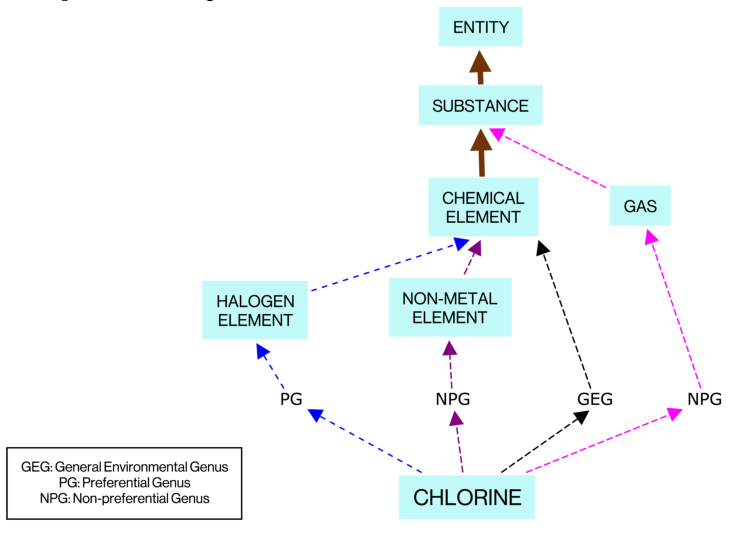
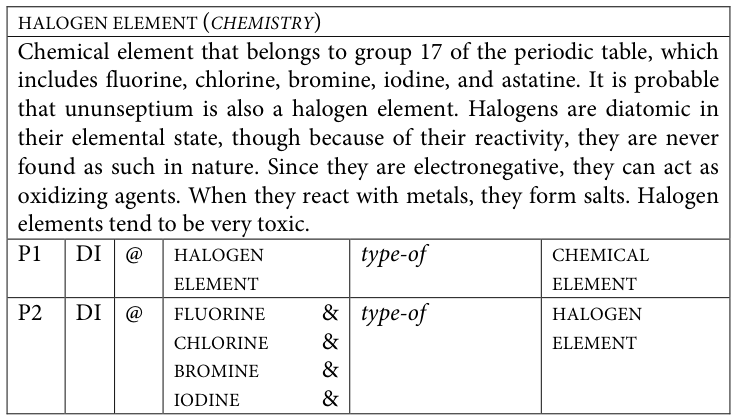
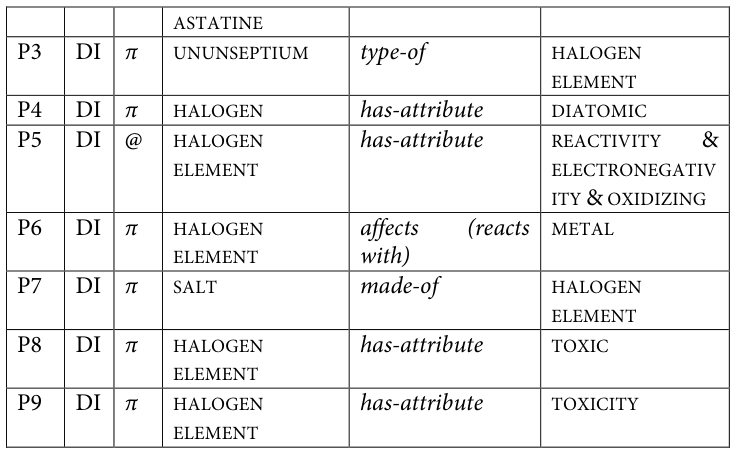
Table 83. Filled-out definitional template of HALOGEN ELEMENT (CHEMISTRY domain)
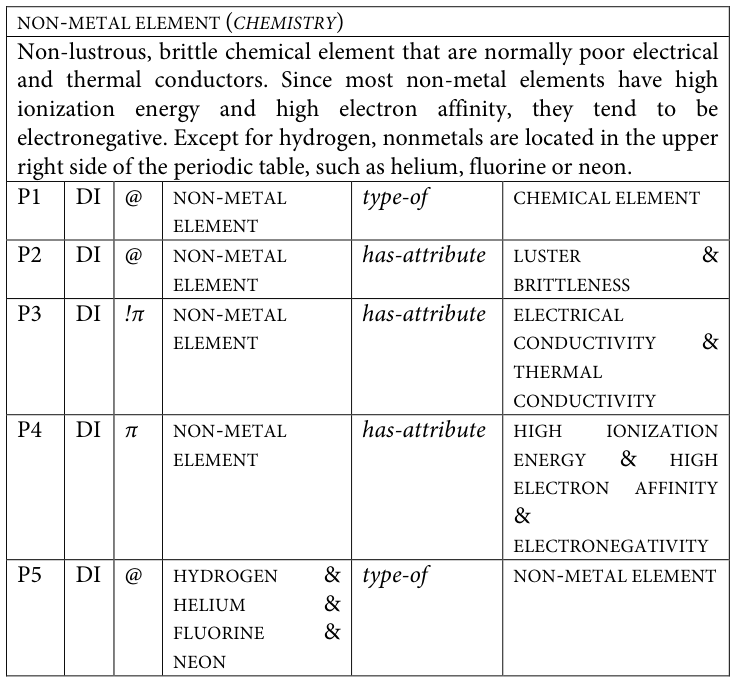
Table 84. Filled-out definitional template of NON-METAL ELEMENT (CHEMISTRY domain)
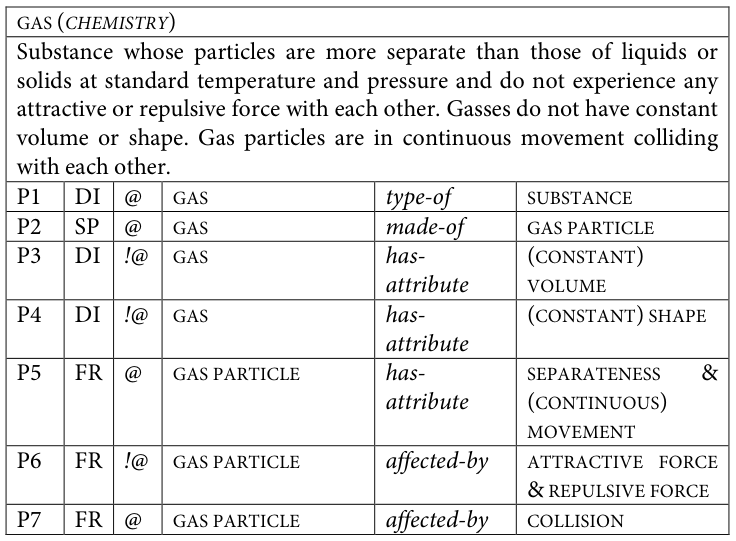
Table 85. Filled-out definitional template of GAS (CHEMISTRY domain)
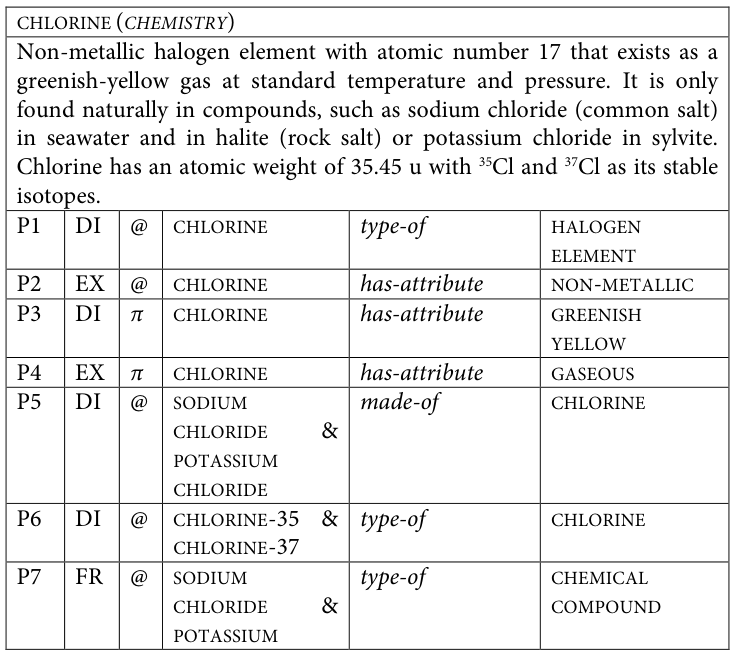
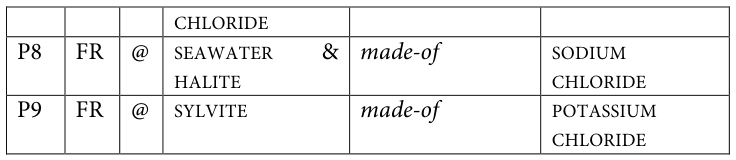
Table 86. Filled-out definitional template of CHLORINE (CHEMISTRY domain)
Many of the characteristics that were relevant according to the analysis of the definitions of other resources and contextonyms were not represented in the definition because they have already been described as part of its genus HALOGEN ELEMENT. Examples of this are as its reactivity, electronegativity or its oxidizing power.
CHLORINE also inherits from its non-preferential superordinate concepts NON-METAL ELEMENT and GAS. In this case, instead of inheriting selected propositions from them, we opted for adding two attributes that indicate that chlorine is also a GAS and a NON-METAL ELEMENT (P2, and P4).
P2 and P3 are prototypical because CHLORINE is not always gaseous and greenish-yellow in color. However, P4 is absolute because CHLORINE is always non-metallic.
The atomic number and atomic weight cannot currently be represented with EcoLexicon propositions. Moreover, since EcoLexicon is a not specialized in CHEMISTRY, we propose to encode the isotopes of an element as subordinate concepts, although a specific relation would be necessary for greater precision.
The framing propositions in this definition add further information about the two most common CHEMICAL COMPOUNDS where CHLORINE can be found in nature.
5.4.2.4.3. WATER TREATMENT AND SUPPLY definition of CHLORINE
The WATER TREATMENT AND SUPPLY definition of CHLORINE has WATER
DISINFECTANT as preferential genus, and CHEMICAL ELEMENT as non- preferential since it is the general environmental superordinate concept. Both hierarchical paths are depicted in Figure 39.
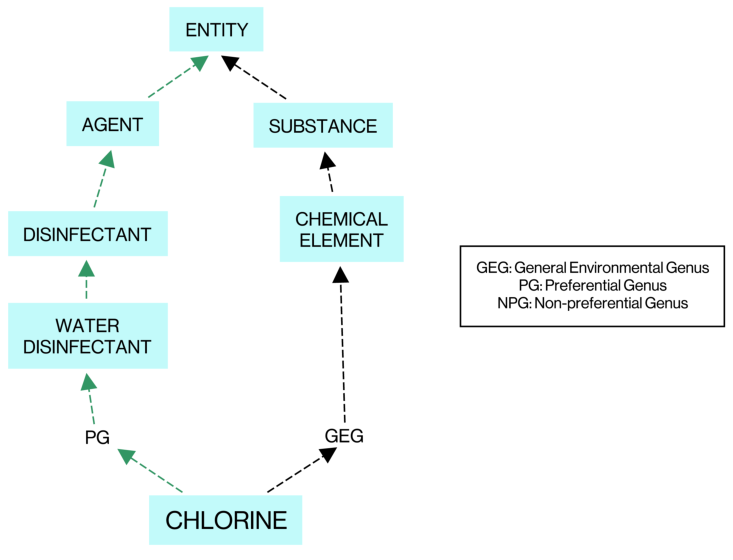
Since ENTITY, SUBSTANCE (Table 77) and CHEMICAL ELEMENT (Table 78) are not contextualized in WATER TREATMENT AND SUPPLY, their general environmental definitional templates apply to this domain too. For its part, DISINFECTANT is subconceptualized as WATER DISINFECTANT in WATER TREATMENT AND SUPPLY. Consequently, CHLORINE in this domain inherits characteristics from DISINFECTANT in its general environmental template (Table 87) and, then, from WATER DISINFECTANT in its WATER TREATMENT AND SUPPLY conceptualization (Table 88). The resulting contextualized definition is shown in Table 89.
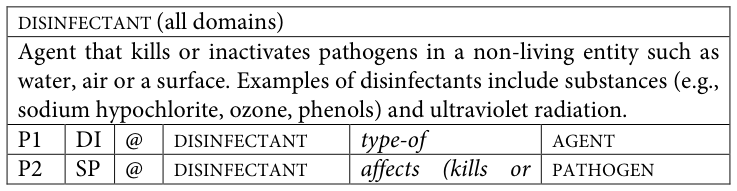
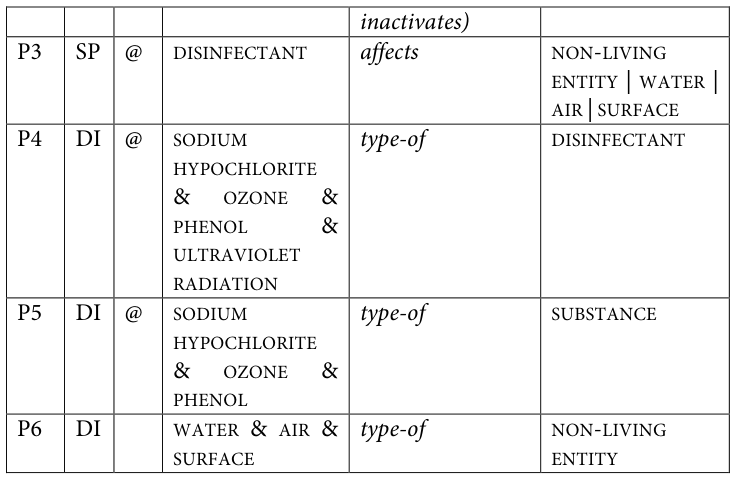
Table 87. Filled-out definitional template of DISINFECTANT (all domains)
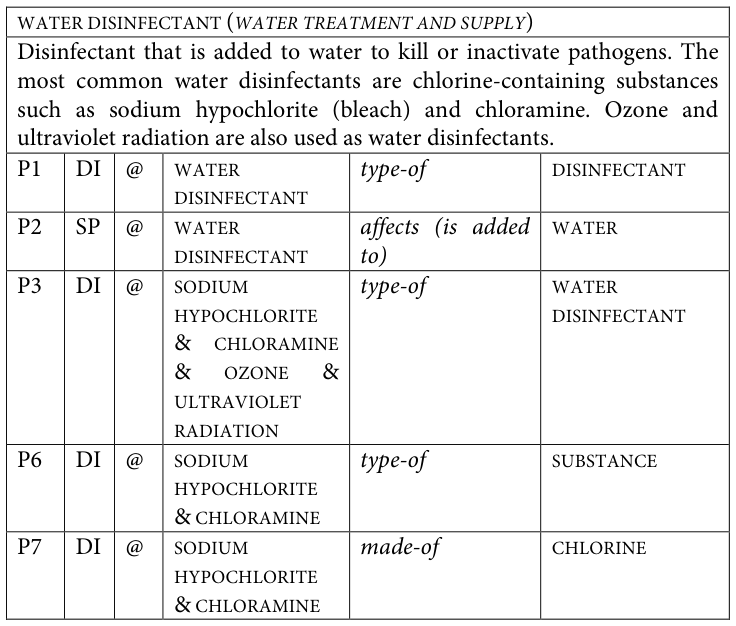
Table 88. Filled-out definitional template of WATER DISINFECTANT (WATER TREATMENT AND SUPPLY domain)
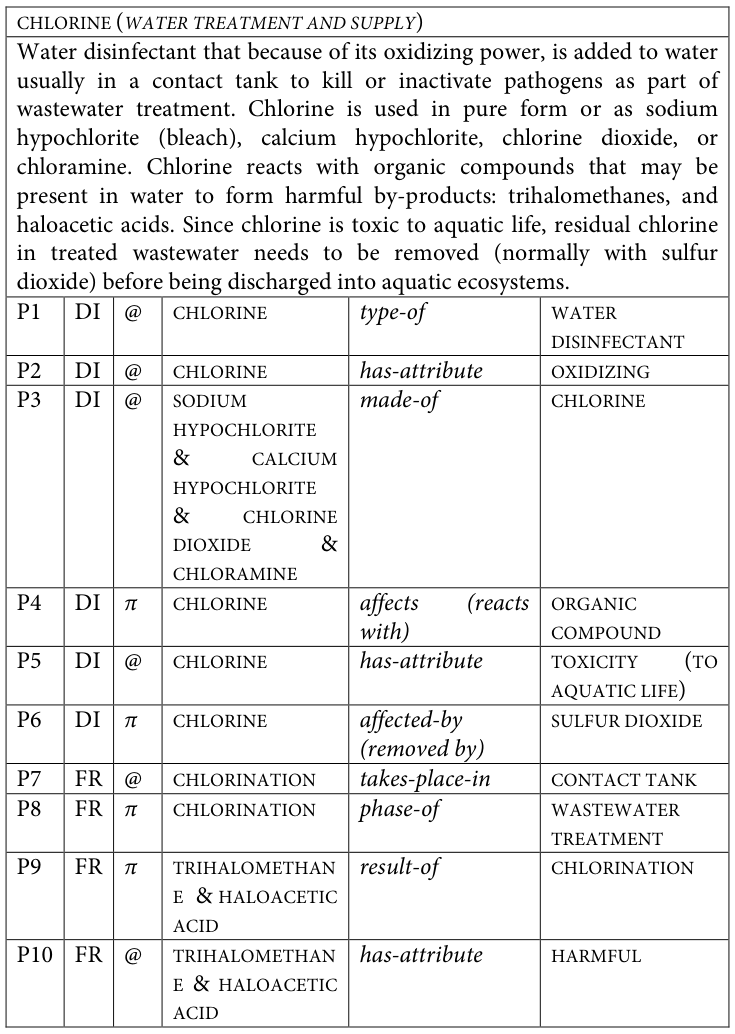
Table 89. Filled-out definitional template of CHLORINE (WATER TREATMENT AND SUPPLY domain)
The contextualized definition of CHLORINE in WATER TREATMENT AND SUPPLY inserts the concept in the frame of CHLORINATION, from which certain propositions are also inferred. However, as with POLLUTANT, the relation «CHLORINE effects CHLORINATION» is not represented in the definition because they are morphologically related, though the user is presented with this proposition in the conceptual map in EcoLexicon. The same is true for DECHLORINATION.
P2 is a direct proposition because HALOGEN ELEMENT (from which it could have been inherited) is not a non-preferential genus of CHLORINE in this contextual domain. Apart from the fact that in the analysis in §5.4.2.3 there was no occurrence of HALOGEN ELEMENT as a superordinate concept of CHLORINE in WATER TREATMENT AND SUPPLY, the term halogen only appears once in the WATER TREATMENT AND SUPPLY subcorpus. Therefore, there was no justification for making HALOGEN ELEMENT a non-preferential genus of CHLORINE in this contextual domain. As a consequence, all the propositions are either direct or framing.
P4 and P6 have prototypical status because they only happen under certain circumstances. P4 refers to the reaction of chlorine with certain organic compounds when it is added to water, while P6 is prototypical because DECHLORINATION is not always included as part of wastewater treatment, and sometimes the use of SULFUR DIOXIDE is replaced by other methods.
The framing propositions in P7, P8, P9, and P10 provide more details about CHLORINATION: where it is carried out, the larger event in which it is integrated, and its drawbacks.
5.4.2.4.4. General environmental definition of CHLORINE
Given that the general environmental definition (Table 90) encompasses all the contextual domains, many of its propositions are shared with those of contextualized definitions. The propositions that do not appear in the contextualized definitions are based on what the analysis of the definitions from other resources and the general environmental contextonyms revealed.
CHLORINE (general environmental) Non-metallic chemical element that belongs to the halogen family and exists as a greenish-yellow gas at standard temperature and pressure. Because of its high reactivity, it is only found naturally in compounds such as sodium chloride (common salt) in seawater, and halite (rock
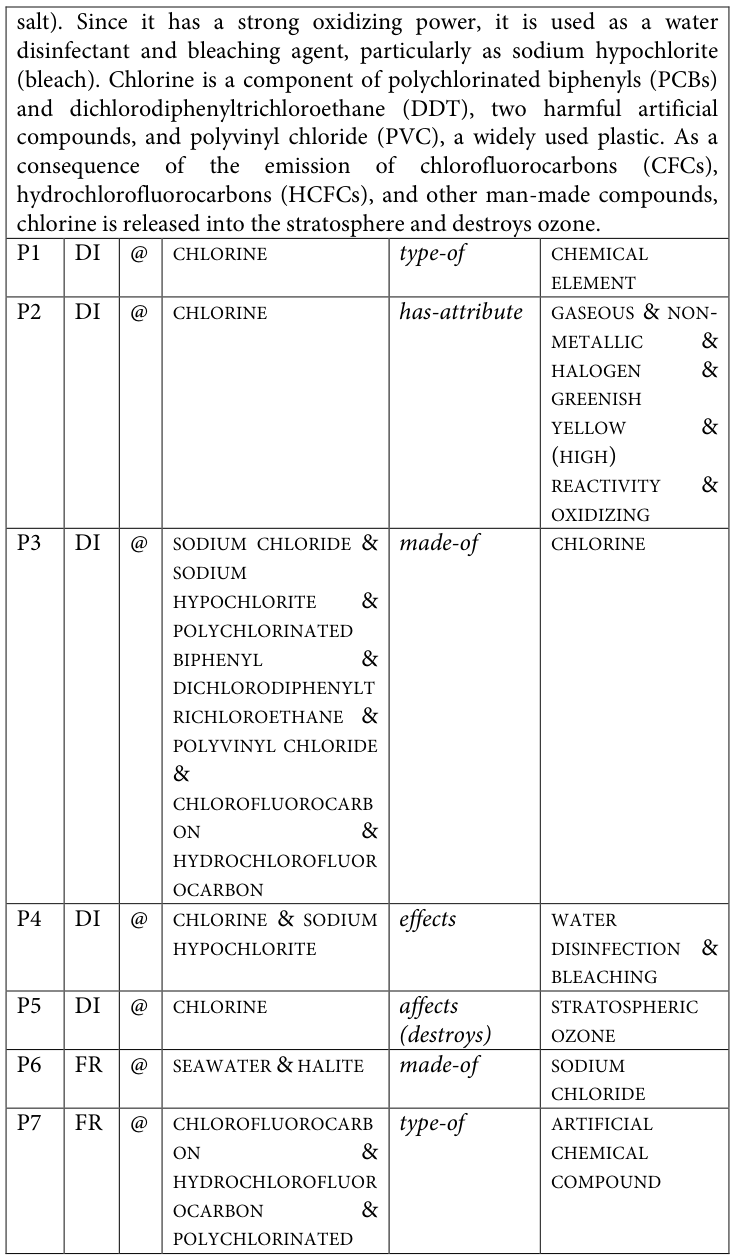
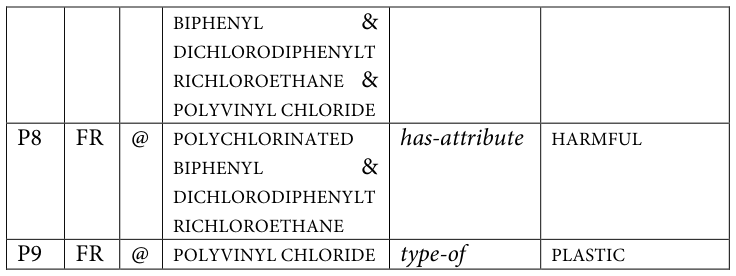
Table 90. Filled-out definitional template of CHLORINE (general environmental domain)
P2 includes six attributes of CHLORINE that are also represented in its contextual domains. GASEOUS, NON-METALLIC, HALOGEN, and GREENISH YELLOW in CHEMISTRY; (HIGH) REACTIVITY in AIR QUALITY MANAGEMENT, and OXIDIZING in WATER TREATMENT AND SUPPLY.
P3 describes all the relevant chemical compounds that contain CHLORINE. On the one hand, most of this information is already present in the contextualized definitions. SODIUM CHLORIDE, as the main natural source of CHLORINE, comes from CHEMISTRY (this proposition is complemented with P6, like in CHEMISTRY). SODIUM HYPOCHLORITE is featured in WATER TREATMENT AND SUPPLY definition, although in this definition, its function as BLEACHING AGENT, in addition to WATER DISINFECTANT, is also conveyed in P4. The fact that CHLOROFLUOROCARBON and HYDROCHLOROFLUOROCARBON are made of CHLORINE originates from the AIR QUALITY MANAGEMENT contextual domain and P5 and P7 further specified that they are artificial compounds that end up releasing CHLORINE into the ATMOSPHERE and resulting in OZONE DEPLETION.
On the other hand, in contrast with the contextual domain definitions, P3 states that also POLYCHLORINATEDBIPHENYL, DICHLORODIPHENYLTRI- CHLOROETHANE, and POLYVINYL CHLORIDE contain CHLORINE. This proposition is complemented with the framing propositions P7, P8 and P9 that add that POLYCHLORINATED BIPHENYL and DICHLORODIPHENYLTRICHLOROETHANE are HARMFUL COMPOUNDS, and that POLYVINYL CHLORIDE is a PLASTIC.
5.4.2.4.5. Flexible definition of CHLORINE
The resulting flexible definition of CHLORINE is reproduced in the following table:
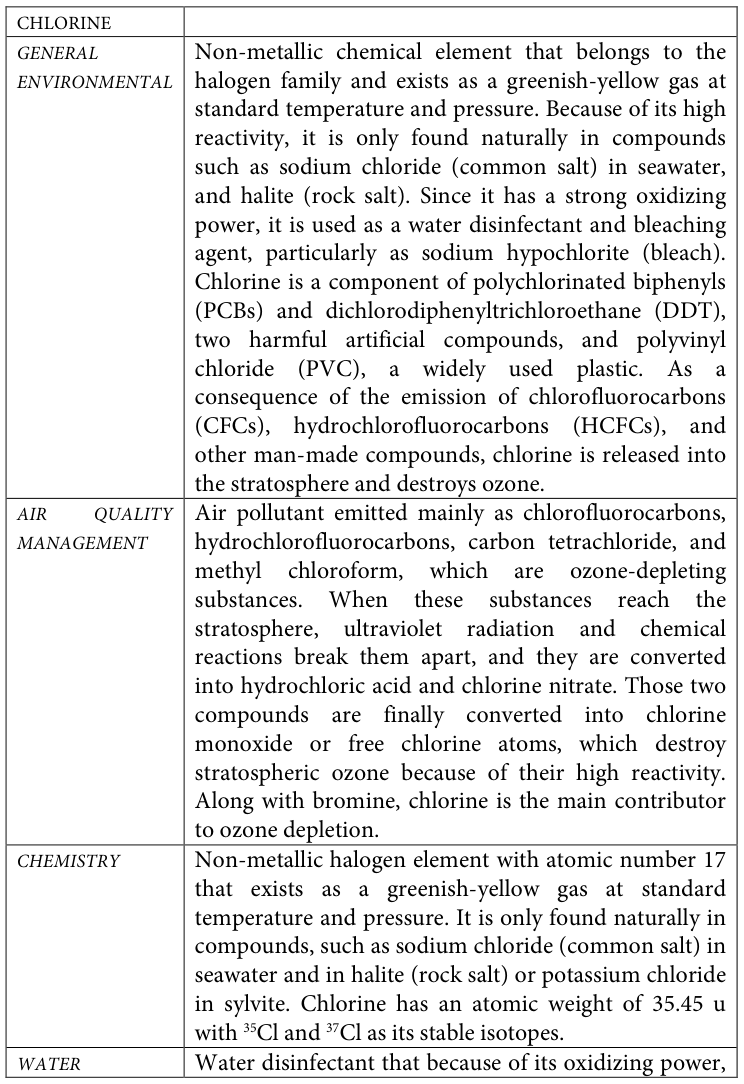
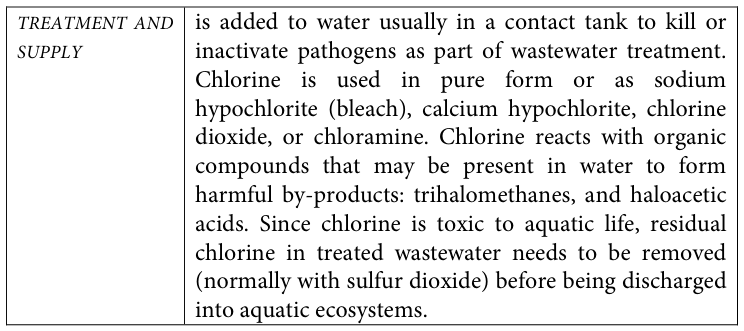
Table 91. Flexible definition of CHLORINE